


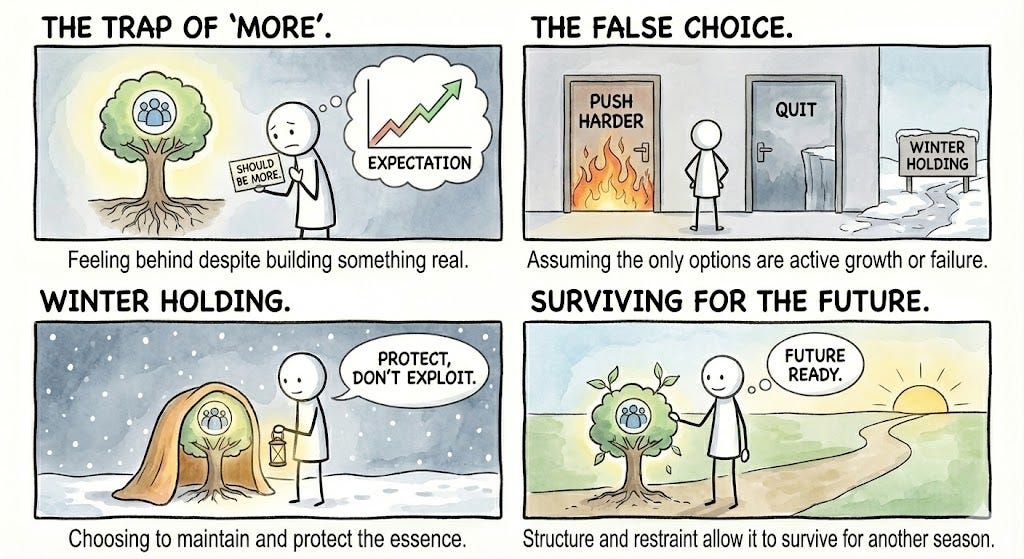
There’s a moment many capable people hit quietly.
You’ve built something real.
Not a fantasy. Not a “one day” idea.
Something that exists. Has users. Has proof. Has history.
And yet, instead of feeling proud, you feel behind.
Because growth slowed.
Because life got heavier.
Because you don’t have the same energy you once did.
So a subtle question starts looping:
“Shouldn’t this be more by now?”
James was in that moment.
He’d built a community that had been running since 2017. Thousands of people. Slow, steady growth. Word of mouth. Real conversations. Jobs landed. Opportunities created. He even made money from it. Not a lot, but enough to prove it worked.
And still, when we spoke, he framed it like a near-miss.
“I haven’t figured out the business side.”
“I had to go back to a job.”
“I feel depleted.”
On paper, it looked like stability.
Inside, it felt like resignation.
This is where many people make a costly mistake.
They assume that if something isn’t actively growing, it must be failing.
They assume that if they’re not expanding, they’re regressing.
They assume the only honorable options are push harder or walk away.
But there’s a third option almost no one names.
Winter.
Not the romantic version.
The honest one.
The season where your job is not to scale, optimize, or reinvent, but simply to hold.
The Slow Growth Season
Most business advice assumes a single, linear arc: idea → traction → scale.
Real life doesn’t work that way.
Real businesses don’t always follow this progression either.
What we see again and again is something closer to seasons.
First, the seed phase.
You create the thing. Energy is high. You experiment. You ship. People respond.
Then summer build.
You add structure. Systems. Rhythms. It becomes more self-sustaining. Still growing, but less chaotic.
And then, sometimes, winter holding.
Life shifts. A child is born. Health changes. A job becomes necessary. Energy narrows. Attention gets divided.
This is where most people panic.
They look at their reduced capacity and assume something has gone wrong.
But often, nothing is wrong.
The project isn’t dying.
It’s waiting.
Winter holding is the decision to keep something alive without demanding more from yourself than you actually have.
You strip back to essentials.
You maintain instead of expand.
You protect the asset instead of exploiting it.
In James’ case, that looked like a simple weekly newsletter. Basic moderation. Letting the community run largely on autopilot without shutting it down, selling it off, or burning it to the ground.
From the outside, it might look passive.
From the inside, it’s disciplined restraint.
The Inner Friction
The hardest part of winter often isn’t logistical.
It’s the rub against your identity.
If you’re used to being the person who builds, pushes, figures things out, then slowing down can feel extremely uncomfortable.
There’s a subtle shame that can start to creep in:
“Other people would do more with this.”
“I should be further along.”
“If I were really committed, I’d find the energy.”
This is where people turn a seasonal reality into a personal indictment.
They forget that capacity is not a character trait.
They forget that timing matters.
They forget that wisdom sometimes looks like not forcing momentum.
Trying to scale in winter doesn’t usually produce growth.
It produces resentment, exhaustion, and sloppy decisions.
And worse, it often leads people to quit things that would have flourished if simply left intact.
Winter Holding vs. Avoidance: A Quick Diagnostic
Here’s the uncomfortable truth: not every slowdown is the right move, or embodied wisdom.
Some people are in a legitimate Winter season.
Others are avoiding the next level of responsibility and calling it alignment.
The difference isn’t how little you’re doing.
It’s whether you’re still in relationship with the thing you built.
Winter holding has three clear markers.
First, you’ve consciously chosen what you’re maintaining.
You can name, in one sentence, the minimum actions that keep the project alive. Not intentions, but actual behaviors.
Second, you’re still paying attention.
You know what’s happening inside the business or community. You’re aware of engagement, quality, and signals even if you’re not acting on them yet.
Third, you feel restraint, not relief.
Winter doesn’t feel like escape. It feels like choosing not to overreach. There’s a quiet tension because part of you wants to do more but you’re honoring reality.
Avoidance looks different.
You don’t want to look at the numbers, the inbox, or the conversations.
You feel immediate relief when you decide to “pause.”
You can’t articulate what “keeping it alive” actually means.
If that’s the case, the issue isn’t seasonality.
It’s fear.
Winter holding keeps the door open.
Avoidance quietly closes it.
A Structure That Holds You
This is where structure matters, but not in the way most people think.
In winter, structure isn’t there to extract output.
It’s there to reduce friction.
The right systems lower the cost of staying present.
A single weekly touchpoint.
A lightweight content rhythm.
Clear boundaries around what you will and won’t do.
Not a new funnel.
Not a rebrand.
Not a complex monetization plan.
Just enough structure to keep the heartbeat steady.
This is one of the core principles of work at Sacred Business Flow:
Structure exists to protect essence, not replace it.
When systems are designed to support your real capacity—not an aspirational version of you—they become stabilizing instead of oppressive.
That’s how something survives long enough to have a future.
A Necessary Line in the Sand
One more thing needs to be said plainly.
Winter is not a license to drift.
If months go by and you haven’t clarified what this thing is for, who it’s for, or whether you’re willing to carry it into a future season, that’s not patience.
Long-term thinking still requires decision.
It just doesn’t require urgency or drama.
At some point, you either recommit with structure and intention, or you consciously let go.
What breaks trust with yourself and with your audience is pretending you’re holding something sacred when you’ve actually stopped choosing it.
Winter demands honesty.
And honesty sometimes means admitting you don’t want this anymore.
That admission is cleaner and more powerful than hiding behind restraint.
Most people don’t struggle with the questions.
They struggle with telling the truth in the answers.
You don’t need to decide the next chapter while you’re exhausted.
But you do need to decide something.
Whether this is a season you’re consciously holding
or a story you’re quietly using to delay a harder choice.
Both are human.
Only one keeps the future open.
If you’re honest, you probably already know which one you’re in.
And that’s where the real work begins.

Happenings
Most people will walk into 2026 carrying everything that didn’t work in 2025.
Same patterns, slightly different calendar.
2026 could be different. The year where the work actually matches what matters. The year where loving more isn’t just an intention scribbled in a journal.
This requires structure. Not the rigid kind that chokes your creativity, but the kind that protects it.
A business that supports how you actually want to live doesn’t happen because you wish for it. It happens because the systems behind it respect what you are trying to create and keep your energy intact.
The breakthrough usually isn’t some massive pivot. It’s organization. It’s looking at the same situation from a different angle. It’s clarity about what actually deserves your attention.
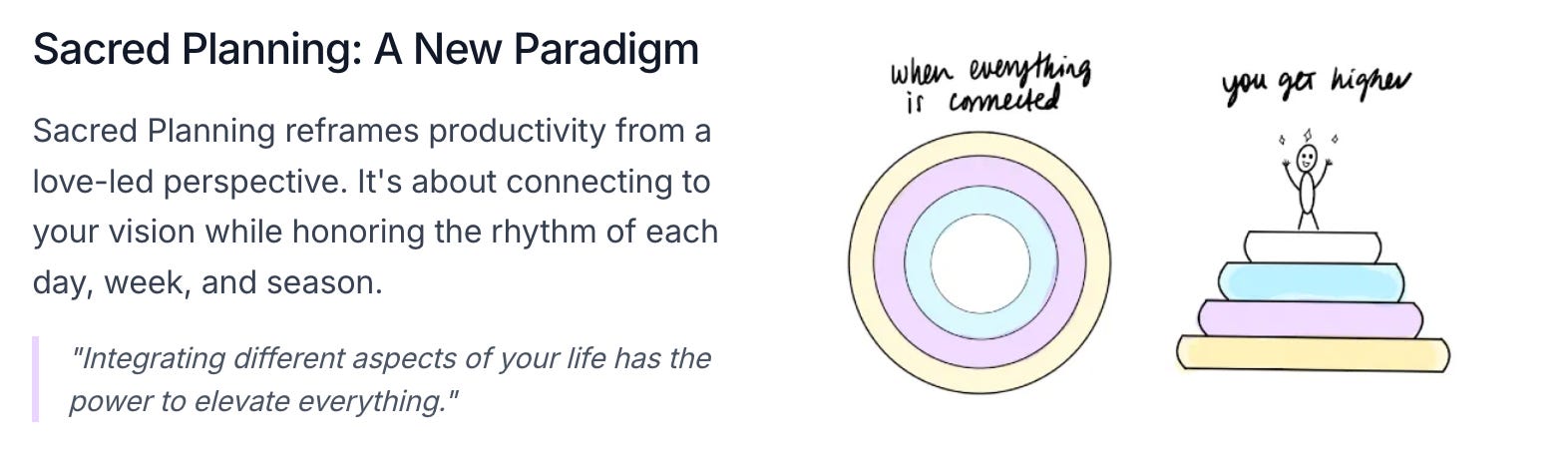
That’s why we created the Sacred Planning Rituals Challenge.
This is a system designed to keep you grounded, regulated, and clear about what comes next, while staying connected to the big picture.
There’s no vision that’s “too big.” There’s only scattered focus.
When every action points back to what matters most, things start to shift. But that requires a structure that moves you forward, not in loops.
If this sounds like what you need, take a look:
Who We Are Celebrating This Week: Jonathan Goodman
Author, “Unhinged Habits” (Jan 2026) | 205,000+ books sold | ex personal trainer | 3x Dad

I’ve really been appreciating Jonathan Goodman and what he’s been putting out lately. 1st - his upcoming book, “Unhinged Habits” is easily one of my most anticipated reads for 2026.
It seems the premise is that major shifts in money, health, and relationships come from deliberate seasons of intensity, not endless consistency.
This connects directly to what I wrote about this week on winter holding.
The essay explores a legitimate season for maintaining instead of expanding. For protecting what you’ve built without demanding more than you actually have.
But I suspect this book is going to be a powerful reminder that sometimes that rocket fuel energy is required to get us to where we are trying to go, and for some period of time it might also look and feel “unhinged”.
I think the discernment is likely in knowing what energy you are operating in, and for how long maintaining it will be appropriate.
Here’s 3 things I’m looking forward to learning from this book:
The 8:4 Rule. The counterintuitive seasonal approach that embraces unbalance to level up your relationships with people, money, and health.
The Explorer’s Compass. A framework to break routine and rediscover wonder in your everyday life.
The Three Proxies of True Friendship. How to categorize your friends so you spend more time with the true ones and feel less guilt for letting others go.
2nd - as Jonathan nears his upcoming book launch, he’s been super generous with sharing his process. As an aspiring author, I’ve found his resources, and window into his thinking very valuable. As you can, see others would agree :)
Give The Man Some Love
We all have doubts sometimes, and especially when we are doing big things that are meaningful and close to our hearts. I think this is one of the best ways we can use Substack. To support other’s in their creator journey.
Things I’d Like to Share
Movie trailers work because they show just enough to create an itch you can’t scratch until you buy the ticket.
This essay by Mia Kiraki 🎭 and Mack Collier breaks down six psychological triggers that work the same way for content, with AI prompts to build each one systematically. The “Identity Mirror” technique alone will change the way you think about writing hooks.

Karen Spinner is on a tear with chrome extensions that actually help creators. One was created to manage her 1,200+ Substack subscriptions locally, the other corrals the prompts we've all scattered across Notes, Docs, and folders we haven't opened for months. The spec-first approach she used to build them is worth the read alone.
Her newsletter has also earned a spot in my inbox this past week.

One of our clients, Josh Woll is throwing an epic reset party this January, and Carolina Wilke and I are participating! If you’d like to experiment with us on what it looks like when you remove alcohol for a full 30 days, definitely check out The Sober Creative Reset.
I also love this trailer he made for the experience using AI:
Memorable Quote
“Plants and animals don’t fight the winter; they don’t pretend it’s not happening and attempt to carry on living the same lives that they lived in the summer. They prepare. They adapt. They perform extraordinary acts of metamorphosis to get them through. Winter is a time of withdrawing from the world, maximising scant resources, carrying out acts of brutal efficiency and vanishing from sight; but that’s where the transformation occurs. Winter is not the death of the life cycle, but its crucible.”
— Katherine May, Wintering: The Power of Rest and Retreat in Difficult Times
P.S. You can read all previous editions of the newsletter here, and you can upgrade your subscription here.
Want to go deeper?
Here’s how we can help you get clear, get visible, and get clients:
Take the Harmony Map Assessment (Free): Find out which pattern is blocking your clarity, visibility, or ability to get the right clients. 8 minutes. You’ll see exactly what’s been in the way, and why strategy alone hasn’t fixed it.
Read the Sacred Business Manifesto (Free): The full philosophy behind how we work, why inner patterns create outer business challenges, and what it means to build from both sides.