


The Ladder Fitness app took me far. I saw visible changes in my body. Strength went up. Muscle showed up where it hadn’t before. Discipline wasn’t missing. Consistency wasn’t missing.
I wasn’t dabbling. I was training regularly and following the program.
From the outside, it looked like it was working.
And in many ways, it was.
This Isn’t About Beginners
This isn’t for people who haven’t built discipline yet. It’s not for people still negotiating with themselves about whether they “feel like” showing up.
It’s for people who already do.
People who are consistent enough that effort is no longer the variable.
This is about what happens after that.
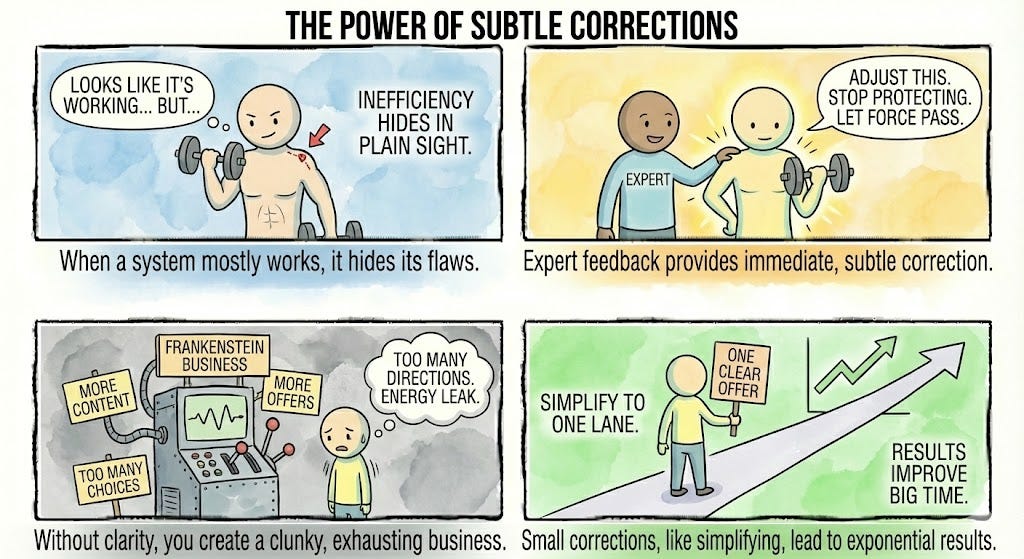
When a System Mostly Works, It Hides Its Flaws
Training on my own, without a coach watching in person, I developed a small movement habit that shifted load away from the joint.
Nothing dramatic. Nothing obvious.
The reps passed casual inspection. The movement “worked.”
But the angle was off ever so slightly.
Not enough to stop progress immediately. Enough to slowly stress my shoulder.
The tricky part was that it felt normal at first. Controlled. Familiar.
The pattern was undetectable while I was doing it.
That’s the danger of systems that mostly work.
When you’re inside them, inefficiency doesn’t feel like you are failing. It feels like normal.
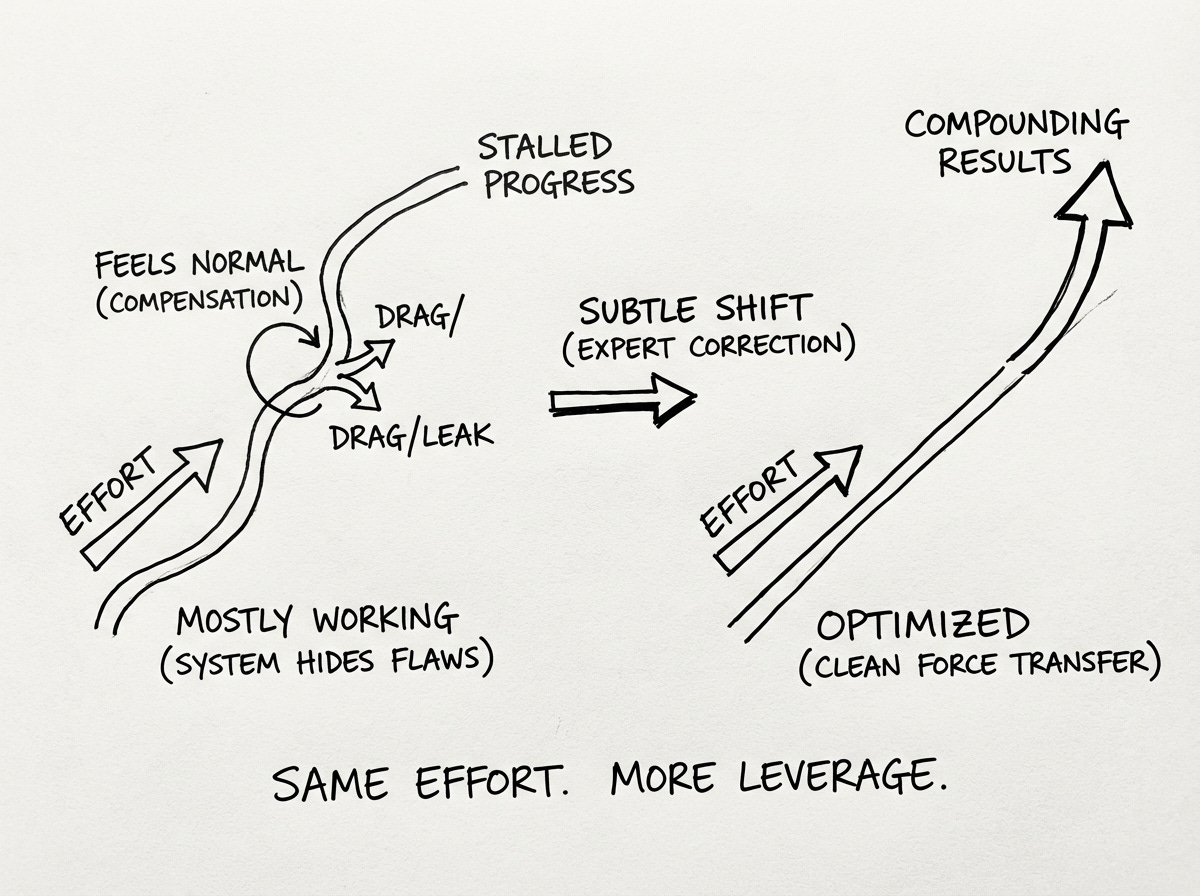
Your body adapts. Your system compensates. Force gets rerouted instead of transferred.
Until it doesn’t.
What Expert Support Actually Looks Like
This is what people misunderstand about one-on-one guidance.
It’s not about learning something new. It’s not about motivation or mindset.
It’s about correction in context.
I eventually went to a Seitai master in São Paulo. His background wasn’t just therapeutic. He also studied movement patterns from jujitsu, not as a sport, but as a way of understanding how force should move through the body.
He didn’t hype me up. He didn’t explain theory.
He watched me stand. He watched me walk. He watched me initiate movement.
Within minutes, he saw what I couldn’t.
The feedback was immediate. Mechanical. Specific.
Adjust this. Brace here instead of there. Stop protecting the joint. Let the force pass through.
The changes were small. Almost boring in how simple they were.
The impact wasn’t.
Force started transferring cleanly again. The shoulder stopped compensating. Progress stopped leaking.
I wasn’t training more. I wasn’t pushing harder.
I was moving correctly.
The Same Thing Happens in Business
I see the same pattern in business all the time.
A creator publishes consistently. The writing is solid. People engage.
Replies come in. Posts get shared. The work lands.
And yet, sales stall.
Visibility without action. Engagement without conversion.
When this happens, the instinct that we want to follow is predictable.
Add more.
More content. More platforms. More offers. More tactics.
But most of the time, what’s needed isn’t more.
It’s a subtle correction in direction.
This is what the Harmony Map reveals. If you read this and felt something click, your results will show you exactly where that pattern lives. 8 minutes.
Take the Harmony Map Assessment →
The Frankenstein Business Problem
I was reminded of this during a coaching conversation with a creator in a very specific niche.
She wasn’t lazy. She wasn’t unclear about her mission.
She had momentum on a good day. She also had too many directions.
Like most creators, she was looking around and borrowing ideas.
“I like what Ana Calin is doing over there.” “I like what Jari Roomer is doing with mini-courses.” “I should probably do a paid newsletter like Laurie Marbas, MD, MBA too.”
So she stitched together pieces from different businesses.
The result was a Frankenstein business.
It technically worked. But it had too many moving parts. It felt clunky. It demanded constant energy.
That’s what happens when you copy tactics without understanding the strategy underneath them.
You’re only seeing the tip of the iceberg of someone else’s success. You don’t see the system operating below the surface.
Instead of a monster, you need one simple lane to run in.
The 1,000 Subscriber Reality Check
I know this firsthand.
I used to think I needed a massive audience to make real money.
Then I looked back at my first successful business.
At one point, that business crossed $100,000 per month in revenue. Not forever. Not effortlessly. But long enough to teach me something important.
My email list never grew past roughly 1,000 people.
Not ten thousand. Not a hundred thousand.
One thousand.
That wasn’t an accident. It was a fit-and-offer game, not a volume game.
Deep, not wide.
The people were right. The problem was clear. The offer matched.
At my price point, I didn’t need virality. I needed a handful of yeses per month.
Which is why, when I hear someone say “I need a bigger audience,” what I usually hear is “I don’t have leverage in my offer yet.”
The Menu Problem No One Notices
As we kept talking, another issue surfaced.
At the bottom of her newsletter was a long list of links.
A mini-course. An affiliate tool. A paid subscription. A coaching link.
Each one made sense on its own.
Together, they created paralysis.
When people have too many choices, they don’t pick the wrong one.
They pick nothing.
So the correction was simple.
Delete everything except the one thing that matters right now.
“If you want help, let’s talk.”
One call to action. One next step.
Not forever. As an order-of-operations decision.
Why This Matters More Than Tactics
Early momentum matters. Cash flow matters. Confidence matters.
You don’t get any of those when your audience has to decode your priorities.
This is especially true in sensitive niches, where people won’t comment publicly or self-identify.
They’ll read quietly. They’ll nod privately. And they’ll act only when the path feels safe and clear.
That path isn’t created by pushing harder.
It’s created by sequence.
Story. Context. Insight. Invitation.
Same effort. More leverage.
Where the Compounding Actually Happens
This is why I care so much about small corrections.
The compounding isn’t just in the numbers. It’s in the lived experience as the one who needs to show up powerfully every day in your business.
When you simplify to one lane, energy stops leaking. When you choose one call to action, learning accelerates. When you package an offer with an arc, trust increases.
The effort stays the same.
The results improve big time.
My shoulder is healing now, not because I’m pushing harder, but because of those subtle adjustments I’ve made within my same training plan.
The entrepreneurs & creators I work with experience the same shift.
They don’t add more tactics. They remove drag.
If you’re already consistent and your results aren’t matching the effort, you probably already know where the leak is.
Happenings
The Copywriter Reinvention Project
My friend Kevin Rogers is closing Copy Chief after 10 years. His words:
“Working your way up as a freelance copywriter, in my estimation, is gone as we knew it.”
He’s not wrong. AI didn't kill copywriting, but it killed the middle. What's left is either commodity work or something AI can't touch.
The copywriters who thrive in 2026 won’t be “copywriters” at all. They’ll be something new, built on everything they’ve learned, plus everything they’ve never figured out how to monetize.
We’ve spent the past couple years coaching a handful of copywriters through this exact transition and talking with friends across the industry. The patterns are distinct. The path forward is clear. Most people just can’t see it from inside the problem.
That’s why we’re looking for 5 experienced copywriters to go through our reinvention process as case studies.
Not another positioning exercise. Not “copywriter who does AI.”
A complete business built on your unique combination of gifts that can’t be commoditized or replaced.
We’re announcing Monday. But if you want early access and the best shot at one of the 5 spots, book a call now.
Substack Live with Dr. Kelly Flanagan
Monday, January 19th at 2 p.m. Eastern.
We’re bringing Dr. Kelly Flanagan back for a fireside chat about his new book, The Road Less Triggered, releasing in March. This is our second interview with him. His work is so aligned with what we teach that we wanted to go deeper on the ideas in this one.
He’s going to walk us through The Peaceful Pivot Process, his framework for choosing connection over conflict in triggered moments. More on the book and why it matters below.
We’re giving away 10 copies of The Road Less Triggered. First 10 people to drop a comment in the live chat when we kick off win a copy.
(US-based only, apologies to our international friends.)
Who We Are Celebrating This Week: Dr. Kelly Flanagan
Author, “The Road Less Triggered” (March 2026) | Clinical Psychologist | International Speaker | National Bestselling Author
I’ve been following Dr. Kelly Flanagan’s work for a while now, and his upcoming book “The Road Less Triggered” is one of my most anticipated reads for 2026.
The premise lands squarely in Sacred Business territory: communication doesn’t break down between people, it breaks down within people. The moment you get triggered, you flip from connection mode into protection mode. And that single moment is the source of most disconnection and conflict.
This connects directly to the work Carolina and I do around inner patterns creating outer business challenges. Dr. Kelly’s approach addresses the same truth from a relationship lens: until you master what’s happening inside you, no amount of strategy fixes what’s breaking on the outside.
Our Sacred Business Story episode with Dr. Kelly was one of my favorites of 2025.

His framework for navigating triggers has already had an impact on how I show up in hard conversations.
Here’s 3 things I’m looking forward to learning from this book:
The Peaceful Pivot Process. His proprietary framework for joining the 6% of people who can actually choose connection over conflict in triggered moments.
Creating peace in here that produces peace out there. While your lizard brain tries to force peace externally to feel peace internally, your higher mind can empower you to flip that. His words, not mine.
How to reconcile in minutes rather than months. He says you’ll learn to “leave behind the endless slog of rupture and repair.” If that’s true, this alone is worth the price.
Give The Man Some Love
Dr. Kelly made a New Year’s resolution on December 31, 2020 that transformed his life and became the foundation for this book:
“Moment to moment, I will notice my heart closing and try to open it back up.”
Five years of testing that resolution in real relationships. Now he’s sharing everything he learned.
Dr. Kelly’s pre-order announcement post
Pre-order page with $348 in bonuses
The pre-order bonuses include early chapter access, a 90-minute masterclass ($149 value), launch team access, and 6 months of his paid community ($150 value).

Things I’d Like to Share
ULTRA SUCCESSFUL
Dr. Julie Gurner coaches top percentile executives, and her piece on complexity crystallizes something I see constantly: complexity is easy, simplicity is the harder work.
The CEO quote alone is worth framing. “If someone makes everything complex, they can’t stay in my org. It just makes everything a nightmare.”

RADICAL CONFORMITY
Colin Gautrey writes about power dynamics for senior leaders, but here is an essay on unconditional giving. The thesis: if you’re disappointed someone didn’t thank you, that’s evidence you gave with strings attached.
“Reclaim control. Give freely, or do not give at all. But do not outsource your peace.”

The AGI Games: May the jobs be ever in your favor
The headlines want you to panic. JHong offers something better: prepared confidence. Her advice isn’t about frantically upskilling or hoarding certifications. It’s about picking one small thing, building flexibility through integration, and strengthening the human skills machines can’t touch. “Crawling is how to start,” she writes. Sound familiar?

This note felt very connected to this essay. Thanks Sinem Günel!
Memorable Quote
“The goal of the mentor is not to be right. The goal of the mentor is to help the mentee learn how to learn, understand how to work through the problems they have, [and] navigate challenges.” - Brad Feld
Stuck on what to do next? That’s what the Integration Call is for. 30 minutes. We’ll look at your patterns, your business, and what would actually move you forward.
P.S. You can read all previous editions of the newsletter here, and you can upgrade your subscription here.
Phil! This was the post I needed to read today. I've been thinking loads about how to develop Slow AI and was trying to borrow lots of bits from people I admire here on Substack. However, what I was proposing ended up looking like the Frankenstein's Monster you describe. This has really helped me focus back on to what works for me and my readers grounded in my own expertise. Thanks for the guidance. 🙏
First of all, I love the phrase Frankenstein Business. And you're right. One subtle correction can make a massive difference in your business!