


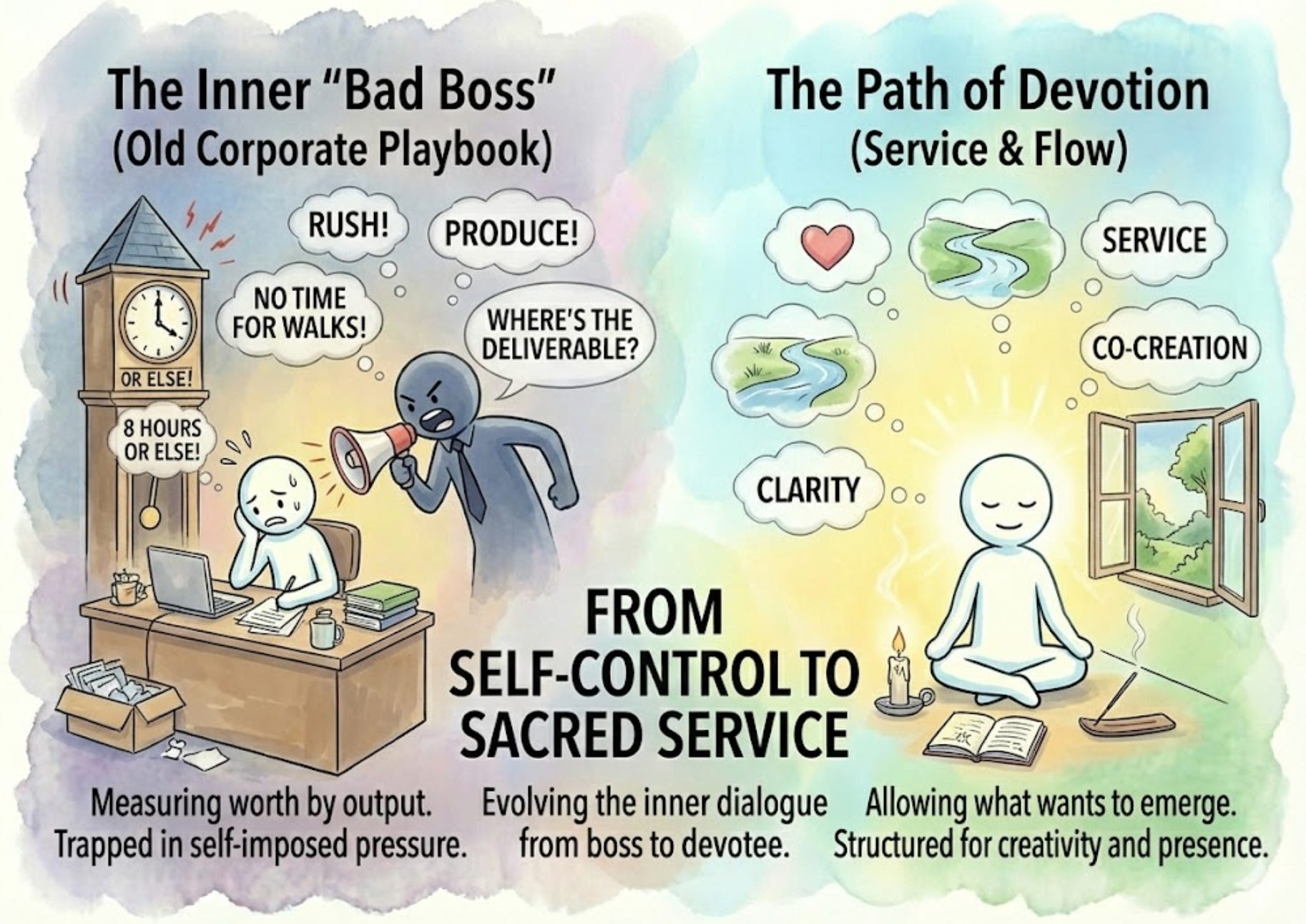
It was probably six months to a year in when I realized I was playing the same playbook as corporate, without even being in corporate.
I was rushing my mornings, rushing with my daughter, because by 8:30am I needed to be in front of the screen working.
In those early days, most of what I was doing was trying to find the language to explain what I was even doing.
I decided to organize workshops and invite my friends and ask them to invite their friends to listen to what I had to share.
So I’d spend time in front of the computer working on that. I’d go for longer walks to think. And at the end of the day I wouldn’t feel like I’d done much.
Clarifying my message wasn’t enough of a task.
It didn’t have a clear output I couldn’t show someone and say “this is what I did.” It was more like a process.
Same thing with the workshops.
Because everything was still being born, a lot of my time went toward exploring angles, studying what could be helpful for people to hear that would help them see if what I had to offer would help them.
But the workshop wasn’t ready to present at the end of my work day either, very differently from all the things I would get done in my previous job.
Walking in nature for me wasn’t part of working. It was walking in nature, even if I was thinking about my work.
It took me years to realize how productive I was being on those walks, but in a different way of being productive.
Another challenge: I wasn’t finding things to do for eight hours straight in front of a computer, so in my head I was procrastinating.
Working meant sitting down for 8 hours and doing stuff!
Work was never about being.
My bossy mind was telling me, “you should be able to get your website up and running in eight hours, why does it take so long? Why do you keep rewriting your intro for this workshop? Just do it.”
My rushed mornings were also me being the tough boss that asks you to sit in your chair for eight hours because this is what the corporation requires from you, even if you don’t have things to do on your computer.
Creating your own business requires a different relationship to creativity that I wasn’t aware of.
Until one morning I woke up and had this thought:
oh shit, what the heck am I doing? Why am I replicating the very things I was trying to escape?
I was so conditioned and so out of touch with my own creativity that I’d lost the ability to create and choose differently.
I was just repeating old patterns.
Being productive meant exclusively getting things done, checking boxes, having something to show for my time.
But there’s another way of being productive.
It’s the kind where you take action, then step back to clarify. Where you talk to people and your message gets sharper. Where you rewrite your workshop intro for the tenth time because each version reveals what you’re actually trying to say.
Where you do volunteer work to practice being in the identity of someone with a real offering. Where you find places to expose yourself and your work, even when it’s not fully formed yet.
This kind of productivity doesn’t give you a deliverable at the end of the day.
It gives you clarity. But I couldn’t see that then. All I could see was that I didn’t have eight hours of tasks to check off.
In my head, none of what I was doing was real work.
And when I sat in front of a computer, it would be incredibly frustrating that I didn’t have eight hours of things to do.
Here’s what’s wild: my last boss in the corporate world was actually kinder to me than I was being to myself. I’d left to go after things that were important to me and experience more freedom. But I just brought the parts of me that had kept me in a cage all along.
Reading Veronica Llorca-Smith’s article “Being Your Own Boss Doesn’t Make You A Good One” this week actually inspired me to write this piece and reflect on how far I’ve come.
She says: “we are often tougher on ourselves than we are on others and operate in ways we couldn’t ask of our team.”
This was so true in my own reality.
The inner talk was harsh and because we don’t say it out loud, it becomes acceptable, the level of criticism and pressure we add to ourselves.
Over the years, I’m becoming a better boss to myself. But more than that, I’m evolving to not needing to be a boss anymore. I’m evolving my relationship with myself, with control, and with my business.
Through the work that we do, I’ve grown so much into the frequency of Service that the boss I needed at the beginning is needed less and less.
Our structures continue to evolve, but at this point discipline has evolved to devotion and structure has allowed my flow with focus.
Service is meeting what’s in front of you with less judgment or opinion about how things should be. It’s showing up for what’s actually here instead of forcing what I think should happen.
The energy of devotion in a business is powerful.
That feeling of “I don’t want to post, I don’t want to be seen” doesn’t truly matter anymore. The opinions about posting consistently, sharing authentically, making mistakes... it’s not heavy. It doesn’t have power over me.
I’m serving and doing what’s been requested of me.
And when you truly serve you don’t need a bossy mind criticizing you to do more, because you just do it from love.
It’s not that the bad boss is completely fired.
She shows up from time to time. But the more I lean into service and have the right structure in place, the more I have space to surrender. And in that surrender, action happens.
Maybe one day the tough boss will disappear completely, who knows. I’m holding the possibility.
What’s helped me most isn’t a perfect system. It’s remembering this work isn’t about control. It’s about allowing what wants to emerge.
Small things anchor me back to that. Lighting a candle or incense before I work and asking for guidance. Not because it’s productive, but because it reminds me I’m not doing this alone. Even simple tasks like emails, the initial organization of my day that could feel less sacred, have a touch of the divine in them now.
This helps me approach my day with presence and joy.
And yes, my week is very well structured.
But now that structure serves something different. It creates uninterrupted time for creativity. Space to pause and listen. Room for ideas to ripen without forcing them.
When an inspiration comes, I don’t have to drop everything and chase it. I have space in my week where it can land. And if I’m not ready to act on it today, that’s okay too. I can revisit it later.
The structure holds me so I don’t have to grip so tight.
That’s the shift.
Being a boss meant controlling outcomes. Being in service means creating conditions for the business to flow through me.
I don’t have to figure it all out alone. I just have to honor the ideas, the sparks, the whispers that come.
Entrepreneurship requires a level of commitment that’s different from corporate. You’re responsible for your own success, and that weight can lead to rigidity in how you treat yourself.
But what if we’ve been asking the wrong question?
This is about recognizing your relationship with yourself....
What’s the self-talk like?
Would you let someone speak to your team that way?
Would you accept that kind of pressure from anyone else? Would you do that to others?
What began as obligation and commitment and “I have to” became “I want to” and this is so much fun.
That’s the evolution I didn’t know I needed.
So I’m wondering: what type of boss are you being to yourself right now? And what would it feel like to serve your business instead of trying to control it?
With Love,
Carolina
This is what the Harmony Map reveals. If you read this and felt something click, your results will show you exactly where that pattern lives. 8 minutes.
Happenings
Meu Sagrado Business (Our Portuguese publication on Substack)
This piece started as a response to Veronica Llorca-Smith's article, but it's become so much more than that. Our conversations during Sacred Business Stories episode and the talks we've had after have been sparking something in me.
She inspired not just this essay, but something I've been holding in my heart for the longest time … we're launching our publication in Portuguese.
Yaaaay!!!!
This has been a desire in my heart forever. We’ll be serving in a different way, focused more on our written content than calls or community for now, but it lights up my heart big time.
And you know where it was born? Out of pure fun and joy.
This was actually how I spent a few hours on my birthday, and it was exactly what I wanted to do. This project has great potential in terms of expansion, but it‘s main reason to exist is because it brings me joy… and I believe this is enough to bring something into existence.
If you know Portuguese speakers who would benefit from our content, please share the word.
Things I’d Like to Share
Sacred Business Stories
If you missed this week’s episode here is the link for you! Maybe it will inspire you to take some powerful action the way it inspired me.
Why We Avoid Hard Things (And How to Start) - great article by Laurie Marbas, MD, MBA
I wanted to share this article because it’s full of helpful information on how to actually start taking action. And I believe once you take small actions and see yourself moving forward, it contributes to a more loving and peaceful inner conversation.
Laurie brings so much clarity to why we procrastinate and how that harsh inner voice gets created. The myth of the pressure player is especially powerful - it’s not only about getting things done, but cultivating a sense of safety inside.
This is about being and taking the actions that will contribute to your transformation, in a way that you can enjoy the journey and not create more stress in your life.
Research shows that while pressure players might finish the work, they often perform worse and suffer more stress than those who start early.
It’s not about just getting things done!

It’s worth reading and implementing.
Who We Are Celebrating This Week
Sam Illingworth from Slow AI

I want to celebrate Sam Illingworth, who just launched his Slow AI Curriculum for Critical Literacy - a 12-month programme that asks the questions about AI we actually need to be asking.
Sam is a Professor and poet in Edinburgh who writes with this rare ability to make you pause, think deeper, and question the rush we’re all feeling to integrate AI into everything.
His work is about slowing down in an era demanding we speed up, and honestly, his words touch something real every single time.
I first connected with Sam when he wrote a post about AI-generated comments… how they weaken authentic connection in our writing spaces. He invited me to collaborate on a piece with other thoughtful humans, and I couldn’t stop following his work after that.
Sam brings critical thinking to AI in ways that feel essential right now.
His curriculum covers everything from data bias and surveillance to creative agency and ecological costs, not as technical training, but as inquiry into how we want to live with these tools. It’s about developing your own ethical framework, not just learning to prompt better.
If you don’t know Sam’s work yet, I encourage you to explore his publication Slow AI.
And if his approach resonates… if you want space to think critically about AI rather than just use it faster… consider joining his curriculum. The first hundred people get an inaugural rate of £50 for the year. This is the kind of work that raises how we all engage with technology, and I’m grateful Sam is creating it.
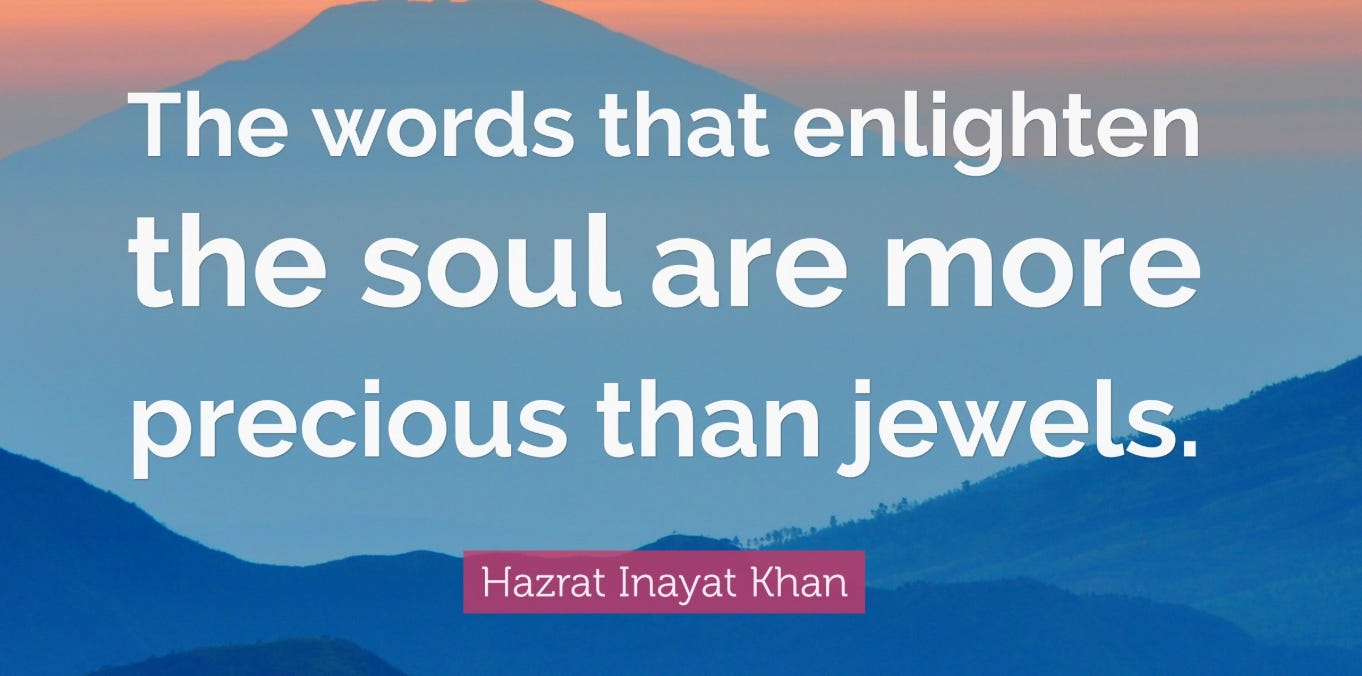
Memorable Quote
What landed for you in today’s issue? If you noticed yourself in this anywhere, you’re already doing the work. The Harmony Map shows you which of the 9 patterns is creating the most friction right now. Your breakthrough frequency might surprise you.
Or just reply or comment below and tell us what came up. We read every response.
I loved this piece, Carolina! It feels like you got the baton and went with it, and we are all building and adding new perspectives on a topic that touches many of us closely.
It's important to unlearn and redefine work, productivity and success. We need a clean page.
Thank you for sharing my Post and congrats on your Portuguese launch, so exciting!
Carolina, first let me say thank you for such a kind and considered shout out. You really went well and beyond here and your words mean an awful lot to me.
Secondly this article resonated with me profoundly as I think about my own current and future career trajectory. It's really important for me not to get lost in the traps of the past and instead to develop what I think you're talking about in this article, which is a state of flow that is synchronous with my mind and body and soul.
Thanks again for such clarity.