


Most people think they’re stuck in their business because they need more clarity, more discipline, or more confidence. But in many cases, the issue is simpler: their work doesn’t have a stable structure around it.
They’re not missing ability. They’re missing a setup that makes the work easier to repeat.
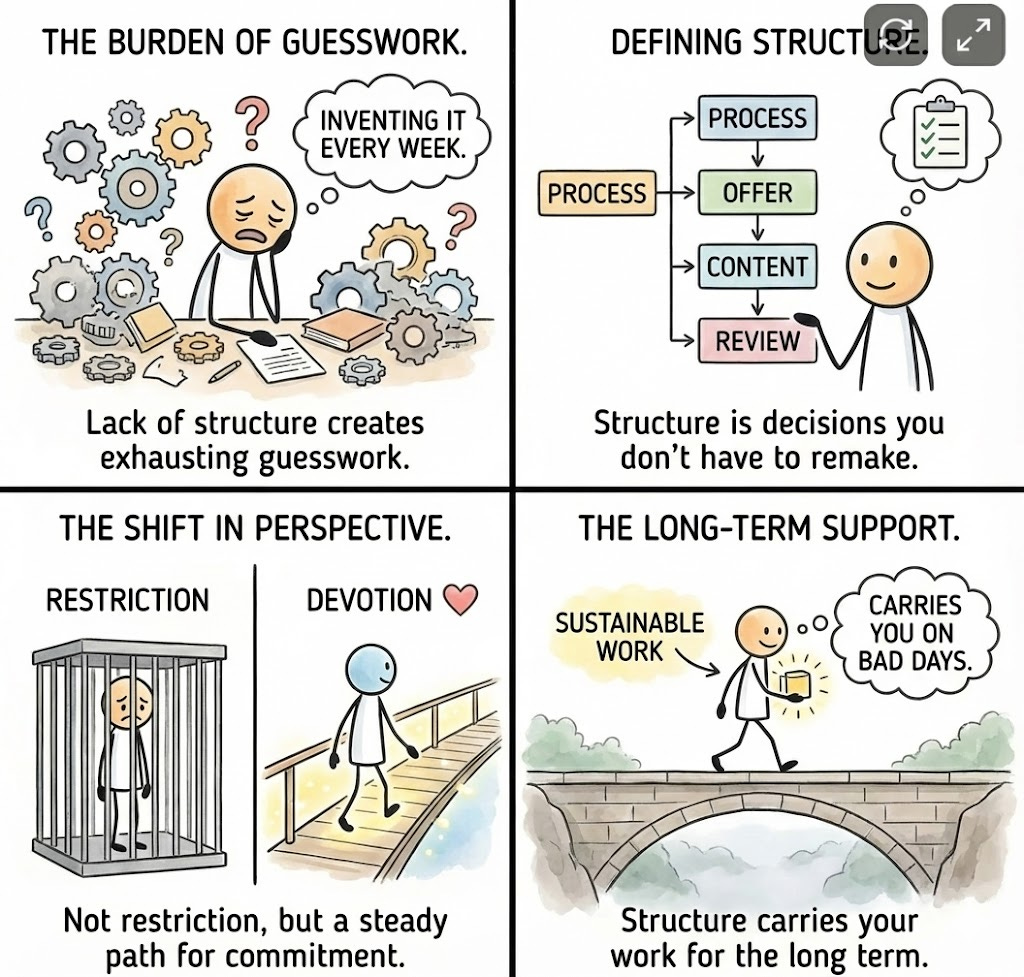
I was talking with someone recently who had a familiar pattern. She had ideas she cared about. She wasn’t flaky, and she wasn’t confused. But anytime she tried to bring an idea into form, she’d get partway there and stop. Not because the idea fell apart, but because there wasn’t a clear way to move it forward. Everything felt improvised.
That’s a structural problem, not a psychological one.
When you’re building something without clear edges or defined processes, every next step requires more energy than it should. Your brain has to renegotiate what to do every time. That kind of friction makes even straightforward tasks feel heavy.
Most people don’t notice this happening. They just assume they’re overwhelmed or “not ready yet.” In reality, they’re operating inside a system that asks them to invent the business again every week.
What Structure Actually Is
The word “structure” tends to get loaded with meaning. For this conversation, keep it simple:
Structure is the set of decisions you no longer have to remake.
Examples:
• how clients work with you
• how you run a session or a delivery process
• where your content lives
• how often you publish
• what you do when an idea shows up
• what you ignore
• what gets a project, and what doesn’t
• how and when you review what you’re building
These aren’t rigid rules. They’re defaults.
When your defaults are clear, your work stops relying on your mood, your confidence level, or your internal weather. The business becomes easier to operate. And you stop losing momentum every time life gets noisy.
Nothing dramatic. Just less friction.
Why People Avoid Structure
Some people avoid structure because they associate it with past environments that were controlling, stressful, or inflexible. Others avoid it because they equate structure with loss of freedom. Others simply haven’t experienced a version of structure that helped rather than hindered them.
Those are understandable reactions.
But a lack of structure doesn’t create freedom. It creates guesswork.
And guesswork is exhausting.
The woman I mentioned earlier wasn’t avoiding work. She was avoiding uncertainty. Every piece of her business required a fresh burst of willpower because nothing existed to support her decisions. Once we talked through it, she didn’t need a huge overhaul. She needed a few decisions she could rely on:
• which offer mattered most
• which platform she would actually use
• what “showing up” looked like in a way she could sustain
• how new ideas would be handled so they didn’t derail her week
Small adjustments. But very real ones.
What Happens When Structure Is in Place
When you have some predictable processes, a few things shift:
• tasks shrink
• decisions take less energy
• work stabilizes
• visibility becomes routine instead of dramatic
• wins compound instead of resetting
• your business stops depending on adrenaline
None of this requires a complicated system. In fact, the more complicated the system, the more likely it is to collapse.
Good structure is boring.
And that’s the point.
What Holds Your Work For the Long Term
If you want to build something that lasts longer than a burst of motivation, it needs to be supported by:
One primary offer that you refine rather than recreate
One primary visibility channel that you actually stick with
One workflow that you repeat consistently
One review rhythm that lets you adjust without starting over
A clear way to handle new ideas so they don’t derail your current priorities
This isn’t “discipline.”
It’s removing unnecessary decision-making.
Most people underestimate how much mental bandwidth they lose to ambiguity. They think they’re tired from work, but often they’re tired from working without any scaffolding around the work.
Where This Intersects With Devotion
If the word “devotion” feels too sentimental, replace it with “commitment over time.” That’s what we’re talking about.
Structure is what allows commitment to be steady rather than dramatic.
Anyone can sprint. Anyone can have a productive day or week. Anyone can be inspired. The real test is whether your system supports you on the days when you’re uninspired, distracted, or dealing with life.
That’s what structure is for.
Not to limit you — to carry you.
What I’m Still Sorting Through
There isn’t a universal recipe for how much structure a person needs. Some people thrive with a minimalist setup. Others need more defined processes. Some people prefer predictability. Others need more room.
The right amount of structure is personal.
The only throughline I see consistently is this: work that matters long-term needs some kind of stability underneath it. Otherwise, it becomes a series of restarts.
Which makes me curious:
What version of structure actually helps you — and what version feels like it gets in your way?
Want to go deeper?
Here’s how we can help you get clear, get visible, and get clients:
Take the Harmony Map Assessment (Free): Find out which pattern is blocking your clarity, visibility, or ability to get the right clients. 8 minutes. You’ll see exactly what’s been in the way, and why strategy alone hasn’t fixed it.
Read the Sacred Business Manifesto (Free): The full philosophy behind how we work, why inner patterns create outer business challenges, and what it means to build from both sides.
What a great post! I used to resist structure because it felt stifling, but now it's honestly made things easier. It turns out freedom is doing your work, not deciding how to do it every day :)