


“I’m scared to show the spiritual and intuitive parts of who I am to certain people, so I hide them. And then I end up building a business that doesn’t even look like me.”
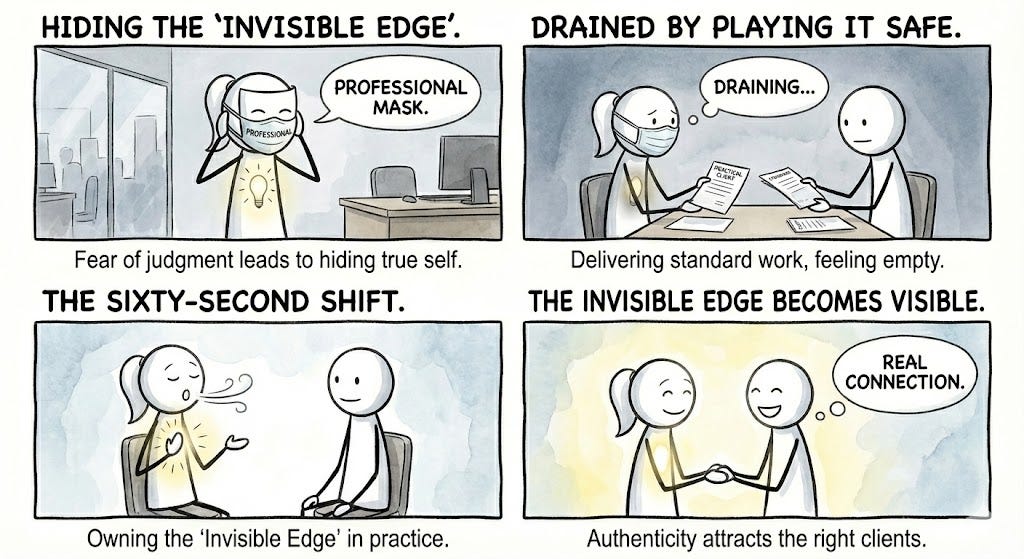
She said this on a call last month. A consultant with twelve years of experience, brilliant at her craft, and completely stuck.
Here’s the part that got me: she helps other people clarify their message and show up authentically. That’s literally what she does for clients.
But her own business? Staying hidden & safe.
When Elizabeth first left her corporate job, things moved easily for about two years. She had a network from her previous work, sure. But something else was happening too.
She had a process that was different from other consultants. Before any strategy session, she’d open with a few minutes of breathing together. Just settling in. Sometimes she’d use visualization exercises to help clients access what they actually wanted beneath the surface-level goals.
She tested this with people she trusted first. Her cousin needed help with a rebrand, so Elizabeth led her through a short meditation before they started working. “I don’t even know what I’m doing,” she told her cousin. “Let’s just try this out.”
Her cousin loved it. Said it was the first time a business conversation had felt like it meant something. A friend had a similar reaction. Then a colleague. The people who experienced this way of working didn’t just say polite things afterward. They came back. They referred others. They said things like, “We’re tapping into something real here.”
Then came the tech startup.
They paid well. They needed a brand strategy. And Elizabeth never mentioned the deeper work because she was afraid the founder would think she wasn’t serious.
“I felt nervous to bring it up,” she told me. “Like he would judge me. He was so practical, so linear.”
That project was mechanical. Draining. She delivered exactly what they asked for and felt nothing. And here’s what she noticed: after she made that decision to hide, she kept making it. The next client seemed practical too, so she didn’t mention the grounding work. Then the next. She wasn’t attracting different clients. She was just saying yes to the same types and hiding more of herself each time.
“After that decision,” she said, “that’s when it kind of fell off track. I fell off track.”
Within eight months, she’d frozen. Referrals slowed. Revenue dropped. She spent close to six months barely able to move her business forward.
When I asked her about her biggest challenge, she said she’d lost her direction. But as we talked, something shifted.
“I do know my direction,” she realized out loud. “I do know what makes my work different.”
So what was the actual block?
“It’s my voice. Owning it. There’s something in me that still doesn’t trust that the real version of what I do is okay to show people. That’s probably been there for years.”
I understand the fear of being judged by “serious” people for bringing the invisible into your work.
The first workshop Carolina and I did outside of Austin felt like a disaster. My old marketing peers were in that room. A decade’s worth of credibility. And there I was on stage, playing music and leading a meditation.
I don’t actually know what they were thinking. But I know what I was thinking: “Who am I to be stepping into this? Are people going to think I’m crazy?”
I almost scrapped the whole plan. Almost went back to conversion funnels and growth metrics. Instead, I closed my eyes, took a breath, and started the music anyway.
Two years later, I can say this: every meeting we run starts with a centering practice now. It’s non-negotiable. And the feedback we get most often isn’t about our strategies or frameworks. It’s “I wish all my business meetings started that way.”
That’s not mystical. It’s just what happens when you stop hiding the thing that makes your work different.
Here’s what I’m coming to understand about this moment we’re in.
AI can write your copy. It can design your website. It can create your content calendar and optimize your funnel. Give it enough data and it will produce something competent, even impressive.
But AI cannot bring presence into a room.
It cannot sit with a client in the discomfort of not-knowing until the real answer surfaces. It cannot hold the space that lets someone feel safe enough to tell you what they actually want instead of what they think they should want.
That quality of attention is what I call the Invisible Edge. It’s the felt difference you bring to practical work. The thing clients struggle to articulate but absolutely notice. The reason someone hires you instead of the cheaper option or the AI tool.
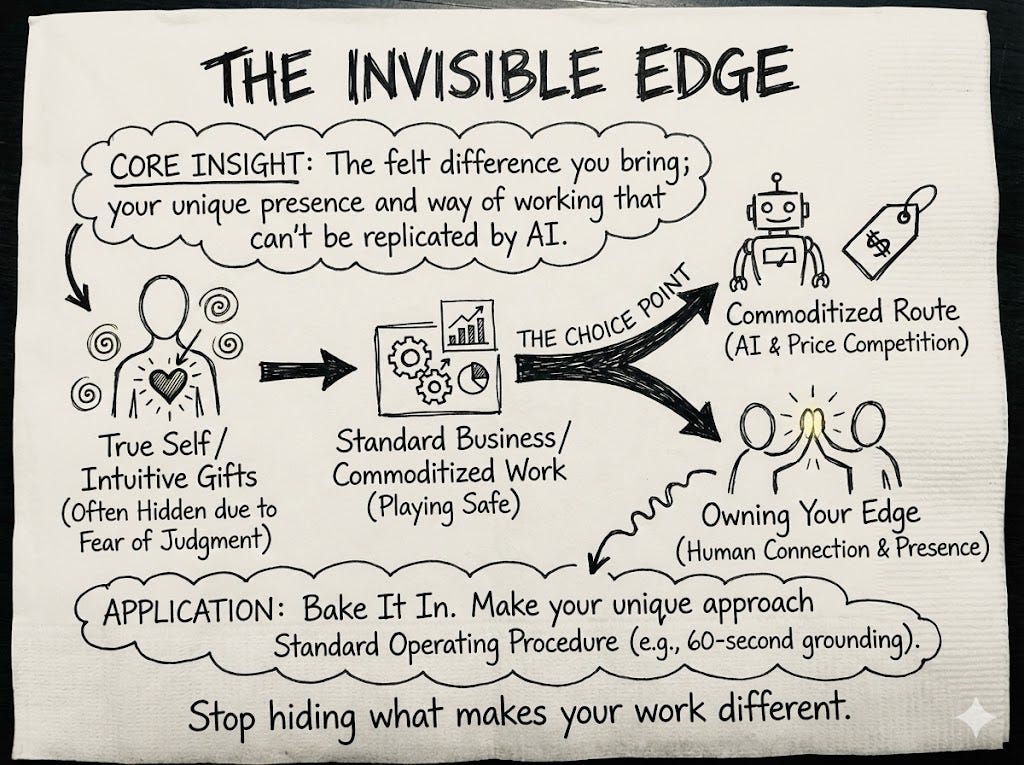
I’m not saying it’s the only thing that matters. Expertise matters. Speed matters. Price matters for some clients. But as more of the tactical work becomes commoditized, the Invisible Edge becomes one of the few differentiators that can’t be replicated.
The problem is that most people hide their Invisible Edge because they’re afraid it will get them rejected.
Elizabeth wasn’t confused about what made her work special. She’d tested it. She’d seen it work. The block wasn’t strategic.
“It feels like there’s an energetic block in my throat,” she said. “I don’t fully trust or own what I have to say. So even when I sense the direction I want to go, I hold back instead of standing firmly in who I am.”
That’s not a positioning problem. That’s an identity problem. And it doesn’t get solved by better marketing tactics.
Here’s what happens when you hide: your business starts looking like everyone else’s. The clients who would resonate with your actual gifts can’t find you, because you’re not showing them. You end up competing on deliverables and price with people who don’t have what you have.
Elizabeth told me she literally advises her own clients to follow their hearts. “Just be yourself,” she tells them. “Screw the strategies. Go with what’s true.” And she watches them open up.
But for herself? “I’m doing it to myself and I’m like, I don’t want to do this. There’s this ick factor.”
I see this pattern constantly. You can transform everyone except yourself.
The shift isn’t complicated. It’s just uncomfortable.
You stop treating your Invisible Edge as an optional add-on and start treating it as standard operating procedure. You bake it into your process so it’s not something you decide to include or hide based on how “practical” the client seems.
What does that actually look like?
For Elizabeth, it could be as simple as this: every call starts with sixty seconds of settling in. “Let’s just take a breath before we start.” No elaborate explanation. No asking permission. She’s her own boss.
I told her she could make that decision today. Not after she figures out her positioning. Not after she gets more confident. Today.
“Most people might think you’re a little different the first time,” I said. “But then they’re probably going to be like, ‘That was nice. I’ve had a crazy busy day too.’ And before you know it, they’re telling other people, ‘I don’t know what it is, but I get on a call with her and I feel completely different afterward.’”
That’s the Invisible Edge becoming visible. Not through explaining it. Through doing it.
Two entrepreneurs can execute the exact same strategy and get different results.
Same social media posting schedule. Same kind of messaging. Same calls to action. One builds real relationships and attracts clients who already feel connected. The other feels like they’re shouting into the void.
The difference isn’t always the strategy. Sometimes it’s the energy behind the strategy.
I don’t mean that in a woo woo way. I mean: are you posting because you want to be seen in your truth, even if some people don’t like it? Or are you posting what you think you “should” post, trying to prove something, seeking validation?
Same action. Different internal experience. Often, different results.
This is what traditional business advice tends to miss. The tactics matter, but so does who you’re being while you execute them. Not instead of strategy. Alongside it.
Elizabeth’s real block wasn’t direction or positioning or marketing strategy. It was her relationship with being seen. The willingness to show the real version of her work, even when it feels risky.
That’s an inner shift. No funnel creates it. No template shortcuts it. You either decide to stop hiding, or you keep building a business that doesn’t look like you.
I’m still working on this myself. Two years in and I still catch myself editing in certain rooms. Last month I was on a call with someone who felt very “corporate” and I noticed myself toning it down. Playing it safe. Choosing the professional version instead of the real one.
Old patterns don’t die. They just get quieter.
So here’s what I’m thinking about: what’s the sixty-second version of your Invisible Edge? The thing you’d do at the start of every client conversation if you weren’t worried about being judged?
Mine is the breathing. Carolina’s is asking people to feel their feet on the floor before we start. A client of ours lights a candle on camera and says nothing about it.
What’s yours? I’d genuinely like to know.
Want to go deeper?
Here’s how we can help you get clear, get visible, and get clients:
Take the Harmony Map Assessment (Free): Find out which pattern is blocking your clarity, visibility, or ability to get the right clients. 8 minutes. You’ll see exactly what’s been in the way, and why strategy alone hasn’t fixed it.
Read the Sacred Business Manifesto (Free): The full philosophy behind how we work, why inner patterns create outer business challenges, and what it means to build from both sides.
Wow, your observation on Elizabeth's hidden intuitive process really hit home. Do you think sometimes the fear isn't just showing up, but how to scale those personal, unquantifable methods into a business without losing their essence?
Thank you, Phil, for writing this post and for sharing Elizabeth's story. I also find it difficult sometimes to talk about the spiritual side of my being. As a scientist and someone who works with AI, I worry that this side of me might not be taken seriously, but it is an inherent part of who I am, and I need to do more to make sure that comes across. Thanks for the reminder. 🙏