



I sent a new Sacred Growth Club member a private message last week. Just a check-in. “Hey, how are the launch numbers looking?”
Her reply came fast. “I just had one registrant. I’m discouraged. I’m struggling to press forward.”
My stomach dropped. Not for her launch. For her interpretation of it.
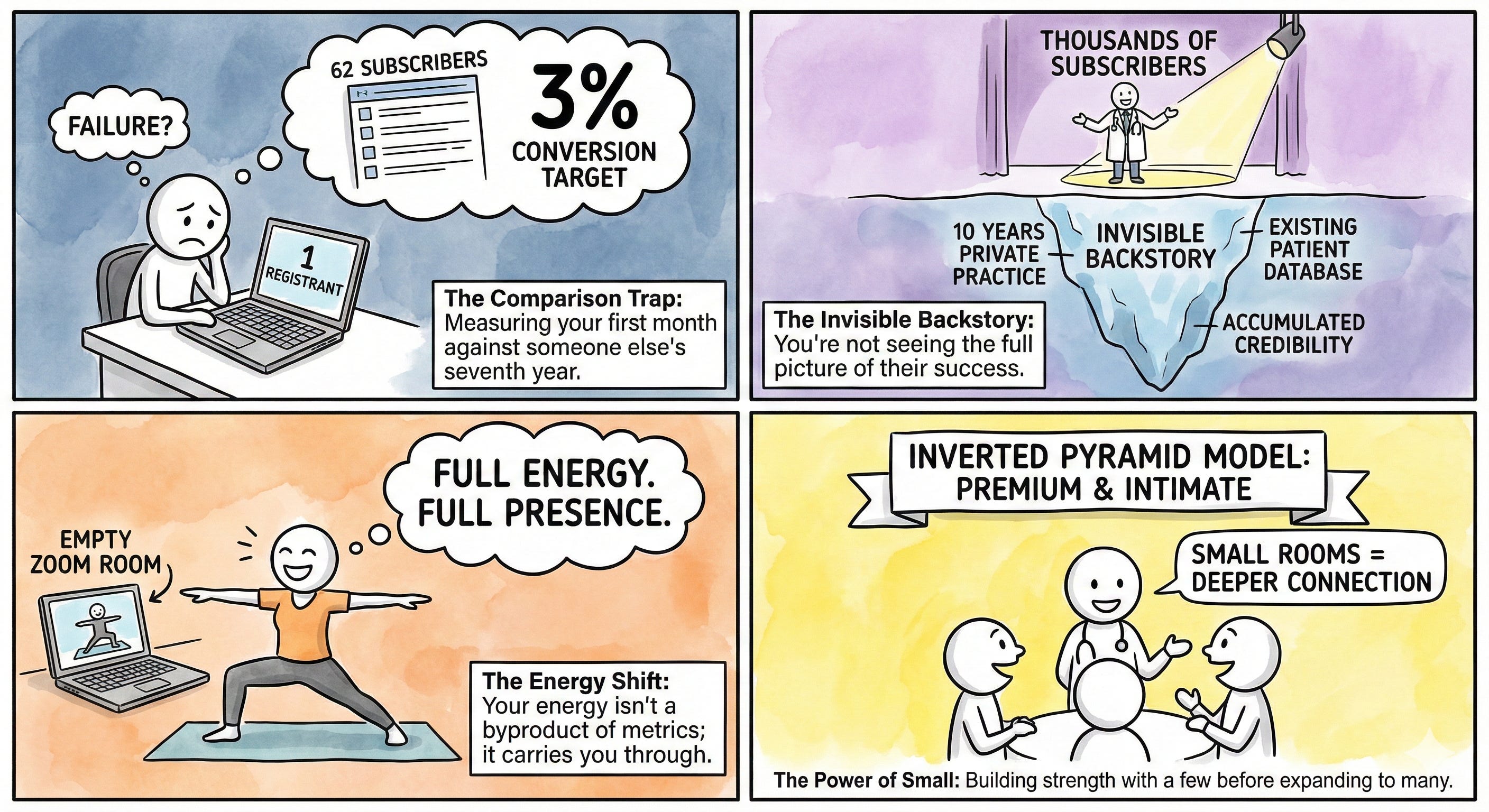
This incredibly talented but new to the game creator has 62 subscribers on her email list. She got one paid buyer. And she saw this as failure.
I grabbed my calculator.
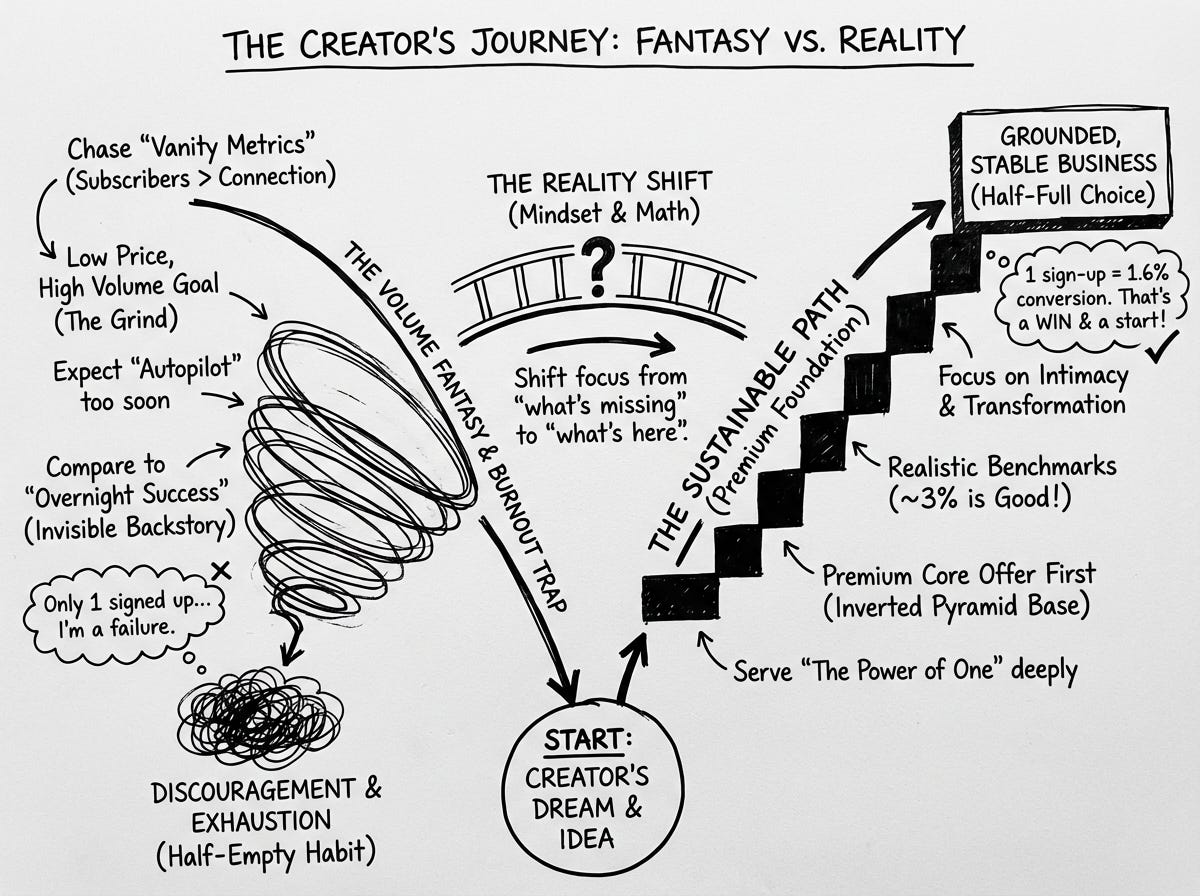
One sale from 62 people is a 1.6% conversion rate. In the world of online courses and cohort programs, 3% is considered best in class. That’s for people who have their messaging dialed in, their avatar clear, and years of marketing experience behind them.
She is a beginner. She got halfway to world-class numbers on her first try.
She wasn’t failing. She was winning. She just didn’t have the right scoreboard.
Here’s what the internet won’t tell you: most early-stage creators are succeeding by every real measure while feeling like complete failures. They’re measuring their first month against someone else’s seventh year. And the gap between those two things looks like evidence that something is wrong with them.
It isn’t.
Let me explain the game that’s actually being played.
The Invisible Backstory Problem
Let’s say a doctor comes online and starts a paid Substack. Within weeks, they’ve got thousands of subscribers. They’re featured on the platform. Everyone’s talking about their meteoric rise.
And you look at your 62 subscribers and think: what’s wrong with me?
Nothing. You’re just not seeing the full picture.
That doctor probably had a private practice for 10 years. Maybe multiple locations. Thousands of patients in their database. When they announced their Substack, they emailed that list. All those years of building trust, all that accumulated credibility, all that effort you can’t see, got compressed into what looks like instant success.
They didn’t grow fast. They migrated.
Not always the case, but a pretty common trajectory. But If that’s you awesome, you have a nice trajectory ahead of yourself here on Substack :)
Same story with the coach who “blew up” on Substack after being invisible for a month. Check their LinkedIn. Check their Instagram. Check their podcast downloads from three years ago. Odds are, they already had thousands of people who knew and trusted them. They just moved that attention to a new platform.
And then there’s the version nobody talks about: paid advertising. Some creators are putting five or six figures per month into ads. They can go from zero to a massive audience in weeks. Completely legitimate. Also completely invisible to you scrolling through their free content.
The people who teach growth rarely mention this. Because their business model depends on you believing the growth was organic, replicable, magic.
If you’ve never built an audience anywhere, you’re playing a different game than these folks. Your timeline should look different. Stop comparing your first inning to their seventh.
The Emotional Roller Coaster
Now, the numbers are one thing. But there’s something underneath the numbers that determines whether you make it past year one.
Carolina and I talk about this constantly. She sees it in our clients. She’s lived it herself. When I asked her to share her perspective on this, here’s what she said:
“Most people treat their energy like it’s an output of their results. Good launch, good mood. Bad launch, bad mood. Numbers up, confidence up. Numbers down, confidence down.
This is a trap. If you play this game, you will quit before any strategy has time to work.
I remember the early days of starting to see clients in my first business. I would open Zoom to teach my yoga class, watch the clock tick past start time, and see the participant count sitting at zero. Just me and my webcam.
The temptation to close the laptop was enormous. What’s the point of teaching to nobody?
But I made a decision in that silence. I would teach the class exactly as if there were hundreds of students watching. Full energy. Full presence. Every pose with intention.
Nobody saw that class. But I did. And something shifted in me that day. I stopped needing external validation to do my work.”
That story has always stuck with me. Because it points to something most business advice completely ignores.
Your energy isn’t supposed to be a byproduct of your metrics. It’s supposed to be the thing that carries you through the seasons when the metrics aren’t there yet.
Carolina puts it this way:
“Here’s what I see over and over: people come into entrepreneurship carrying a pattern from the rest of their life. They focus on what’s missing. What isn’t working. The sale that didn’t happen. The subscriber who didn’t join.
This isn’t a business problem. It’s a life pattern showing up in business.
The same lens that makes you feel behind in your career makes you feel behind in your launch. The same habit of scanning for what’s wrong makes every metric feel like somethings gone wrong. And until that pattern shifts, no strategy will save you.”
She’s right. You get to choose which half of the cup you see. And that choice determines whether you’re still in the game three years from now.
The Sobering Math
Let me give you another example. One of our clients, Josh Woll runs a business supporting people with sobriety (The Sober Creative). Great guy, super solid work. He launched a 30-day challenge in January and had about 20 people to join.
Theres a way in which if his mindset wasn’t dialed it (fortunately it is), he could choose to view these results as small or like he’s somehow not doing things right. Maybe he’s seen other creators with hundreds of participants and assumed he was miles behind.
So I ran the numbers.
He has about 550 subscribers. 20 sign-ups from 550 people is a 3.6% conversion rate. That’s not just good. That’s above the industry benchmark.
And on top of that, people are getting REAL results in his programs.
But here’s where it gets sobering for anyone out there who is just starting out and thinking they want to build a sustainable business on something like this alone.
"To make $5,000 per month selling a $30 challenge or mini-course at a 3% conversion rate, you would need about 5,500 people actually seeing that offer every single month. And since only 20-25% of your list opens any given email, that makes things look even more grim.
Most people don’t have that traffic. Not even close.
And it gets harder. You can’t put the same offer in front of the same audience month after month and expect them to keep buying. That’s called offer fatigue. Your second launch to the same cohort of your overall list will often convert lower than your first. Which means you need a constant flow of new people just to stay even.
So my clients numbers aren’t bad for where he is in his process. But building a financial model based solely on a result like this would be a miss.
This is the math nobody does before they start dreaming about courses and memberships replacing their income. You run the numbers on your list size, your price point, and a realistic conversion rate, and suddenly you see why a small list can’t sustainably support a full-time business on low-ticket offers alone.
I’ll be even more transparent. We recently launched a Planning Rituals challenge to our list. We have almost 25,000 subscribers.
30 people signed up.
My marketer brain wanted to panic. That’s a poor conversion rate by any standard. If Carolina and I were trying to pay our bills with challenges, we’d be out of business.
But then we got on the first group call with those 30 people. The connection was real. The resonance was high. The group was exactly right.
And I remembered why we built our business the way we did.
The Fear Nobody Talks About
There’s another layer to this. Beyond the bad math and the invisible backstories.
It’s the fear of being seen as a failure to the people who actually say yes.
I hear this constantly: “What if only two people sign up? They’ll look around the Zoom room and think I’m a joke. They paid for a group experience and got a glorified 1:1. They’ll feel ripped off.”
This fear keeps people from launching at all. Better to stay invisible than risk the humiliation of a small room.
Here’s what I’ve learned: small rooms are where the magic happens.
When only a handful of people show up, they get more of your time. More of your attention. More of your presence. The intimacy creates connection that a room of 200 never could.
Those few people become your strongest testimonials. Your clearest case studies. Your future private clients.
I’ve been on workshops run by creators with thousands of paid subscribers. Three or four people showed up. I know a New York Times bestselling wellness author who averages under 10 people on her community calls.
If that’s the reality for creators with massive audiences, why would you expect different for yourself?
The small room isn’t evidence of failure. It’s a premium container for transformation.
The Power of One
When I shared these thoughts with Carolina, she added something that I think gets to the heart of what makes the difference between people who make it and people who don’t:
“In the early years, I adopted what I call the Power of One. One more client. One more subscriber. One more person on the call. Full energy to that one soul connecting with me in that moment.
When someone did say yes, I celebrated like it mattered. Because it did.
When nobody showed up, I taught the class anyway. To an empty Zoom. With the same presence I would have brought to a full room.
This sounds irrational until you understand what it’s actually doing. It’s training your nervous system that your energy isn’t dependent on external validation. It’s building the consistency muscle that will carry you through the quiet seasons. It’s proving to yourself that you’re the kind of person who shows up regardless.
That practice compounds. Slowly at first. Then faster.”
I’ve watched her do this. It works.
The creators who survive past year three aren’t the ones who found a growth hack. They’re the ones who could sustain their energy through a realistic build time.
So What Actually Works?
If low-ticket products can’t sustain a business on a small list, and emotional energy is half the battle, what’s the path forward?
This is what we teach inside our signature course, Serve and Receive, and why it exists.
The concept is something we call the Inverted Pyramid.
Most people try to build their business from the bottom up. They create a cheap course or a paid newsletter, hope for hundreds of buyers, and grind themselves into exhaustion chasing volume they don’t have.
The math doesn’t work. You’ve seen why.
The Inverted Pyramid flips this. You start by serving fewer people at premium rates. You build a strong economic base with clients who get your full attention, your best work, your real transformation. And from that position of strength, you expand outward.
This isn’t about charging more for the sake of it. It’s about building a business that can actually support you while you’re learning. One where a small number of the right people covers your bills and gives you breathing room to grow.
Carolina put it simply when we were planning this piece:
“The creators who make it aren’t the ones who found the shortcut. They’re the ones who built something that could hold them while they grew.”
That’s what we’re inviting you into.
As a special gift, we are sharing a Launch Reality Calculator here that you can use to reframe “failed” launches into data. The questions to ask yourself before you panic-pivot after a slow start. The specific conversion benchmarks for different offer types so you can stop comparing yourself to invisible backstories.
Want to talk this through? Book an Integration Call. We’ll look at your Harmony Map results, talk about what’s actually in the way, and figure out if mentorship support makes sense.
Phil, this is absolutely the post I needed to read in the week that I launch the pay tier of Slow AI. My number one worry was being seen as a failure in front of the people that put belief into what I'm doing. Paradoxically, these are the same people who would probably never consider what I've done a failure. It's really important for me to remember that I'm writing yet another post that seems to be in complete harmony with where I am as a creator.
The crazy part is we wrote very similar posts that published on almost the exact same day. I wholeheartedly agree with every single thing that both of you wrote in this post. And I think it's so important for us to pay attention to these little details because like you said our interpretation of the results and how we proceed and how they affect us are what's most important