
When Every Idea Feels Urgent (And None Get Finished)
A grounded approach for creators, coaches, and founders who generate more possibilities than their systems can hold.
Most people think the reason they aren’t consistent is discipline.
In my experience, the real reason is much simpler:
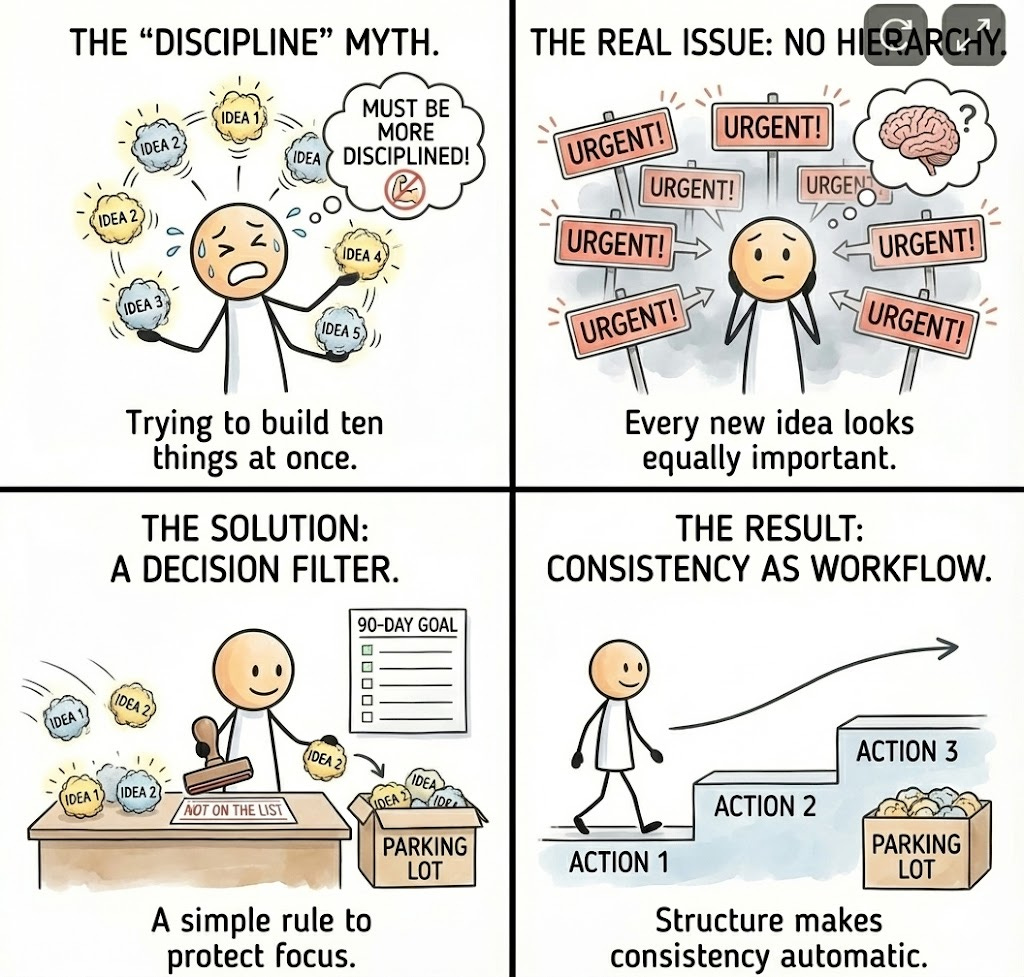
They’re trying to build ten things at once and telling themselves they’re building one.
A recent conversation with a network member was a perfect example. She joined one of our 7-day challenges this past year during a chaotic season.
Brilliant woman. Sharp thinker.
Overflowing with ideas. By day two she had mapped multiple offers, a content plan, and a new direction for her business.
By day three she vanished.
Not because she didn’t care.
Not because she wasn’t capable.
But because there were too many competing priorities, and no clear way to decide which one to follow.
If you’ve ever splintered your attention like this, you know how quickly momentum disappears.
This isn’t a character flaw, it’s an operational issue.
The real pattern: high creativity, low containment
When someone tells me they’re “all over the place,” they usually mean:
• they see possibility everywhere
• their brain generates ideas faster than their systems can hold
• they have more opportunity than capacity
That combination creates a specific problem: every new idea looks equally important from up close.
Most entrepreneurs stop here and assume they need more discipline.
But discipline isn’t the bottleneck.
Decision hierarchy is.
Without a hierarchy, everything feels urgent. Everything looks viable.
Everything has potential.
And potential is the enemy of completion.
A rule that emerged by accident
At one point, Carolina and I noticed how easily good ideas can hijack a week.
So we started saying, half joking:
“Not on the list.”
It wasn’t profound. It wasn’t a special technique. It was simply a filter.
If a new idea didn’t directly support the current 90-day objective, it didn’t get action.
Not forever—just not now.
What surprised me was how freeing this became.
It removed 80 percent of the mental load.
It protected the projects already in motion.
It created a clear signal in a world full of noise.
In other words, it solved the operational chaos that masquerades as lack of motivation.
Why this pattern keeps resurfacing
The real reasons entrepreneurs get pulled off track are straightforward:
They don’t have a simple way to choose what matters.
If there’s no filter, everything fights for attention.They haven’t translated their long-term vision into a short-term constraint.
If you don’t know what “this quarter” is for, you’ll try to solve every problem at once.They treat ideas as instructions instead of information.
Not every idea deserves execution. Some just deserve storage.
This is not psychology. It’s mechanics.
A business without constraints is like a lab experiment without a controlled environment:
you can’t isolate what’s working.
Where structure actually matters
Inside Sacred Growth Club, we don’t ask people to “be more consistent.”
We help them create a decision structure so that consistency becomes almost automatic.
It looks like this:
Pick one measurable 90-day outcome. Something clear enough that you’d know if it happened.
Identify the 3–5 actions that genuinely move that outcome forward. No more than five. Most people only need three.
Everything else goes in a parking lot. Not deleted. Not dismissed. Simply deferred.
Use weekly check-ins to course-correct without blowing up the whole plan. Small adjustments prevent big resets.
When you operate this way, focus stops being a personality trait.
It becomes a workflow.
Why most people fail when they try to do this alone
Could you build a system like this by yourself? Yes.
Will most people sustain it alone? No.
Not because they’re not capable—but because in the absence of external structure, the brain defaults to what feels immediately gratifying:
• new ideas
• new strategies
• new directions
• new advice
Every shiny idea feels reasonable in isolation.
It’s only when you see them lined up against a real 90-day goal that the difference between “interesting” and “important” becomes obvious.
Where guidance fits in
Good guidance isn’t about giving people endless tactics.
It’s about giving them a frame strong enough to hold their creativity without crushing it.
When people plug into our system, they get:
• a clear hierarchy of priorities
• a simple plan that doesn’t collapse when life gets noisy
• a way to store ideas without acting on them
• a rhythm that makes visibility and client attraction sustainable
• feedback loops that reduce second-guessing
None of this replaces their creativity.
It just channels it.
Structure isn’t a cage—it’s a conduit
The belief that structure kills creativity is one of the most expensive misunderstandings in entrepreneurship.
Structure doesn’t limit your ideas.
It protects them from being spread so thin that none of them take shape.
A 90-day focus gives your work a place to land.
A parking lot keeps your ideas safe until the right moment.
A simple weekly rhythm keeps the system alive without burning you out.
Most entrepreneurs don’t need more ideas.
They need a smaller list—and a way to trust it.
And that brings us here.
So instead of trying to finish every idea you have, try something simpler:
Pick one result.
Pick a short list.
Protect it.
And then notice what happens next.
Because the real turning point isn’t choosing a 90-day outcome—it’s noticing what you instantly feel tempted to add on top of it.
That’s the pattern worth paying attention to.
So I’m curious:
What’s the thing in your world right now that you know isn’t on the list… but keeps stealing your attention anyway?
Drop it in the comments.
Seeing it in writing is often the first moment it loses its grip.
Want to go deeper?
Here’s how we can help you get clear, get visible, and get clients:
Take the Harmony Map Assessment (Free): Find out which pattern is blocking your clarity, visibility, or ability to get the right clients. 8 minutes. You’ll see exactly what’s been in the way, and why strategy alone hasn’t fixed it.
Read the Sacred Business Manifesto (Free): The full philosophy behind how we work, why inner patterns create outer business challenges, and what it means to build from both sides.


thanks for the stack @Helene K what is “not on the list” for you? We’ve all got them!
I see this with a lot of founders. They think it's a discipline issue but are really just trying to build ten things at once while telling themselves they're building one.
It's not lack of capability, it's too many competing priorities, with no filter for what actually matters. No wonder we all, at one point, burn out.
Great post, thank you!