


This morning, I followed up with someone I have known for about two years.
They first came into our community with a real desire to build something of their own. They were thoughtful. Capable. There was genuine passion behind the work.
And every so often, our paths would cross again.
Each time, I heard some version of the same thing:
“I think I’m going to keep trying this on my own a little longer.”
I respected that. I still do.
It is never my place to force advice on someone who has not asked for it. Even when I can see a pattern that concerns me, I do not want to become the person who assumes he knows someone else’s life better than they do.
So I stayed in touch. I checked in. I watched them keep trying.
Then, two years later, came the update:
They were going back to a job.
The business had not worked.
There is nothing wrong with returning to employment. Sometimes a job is the wisest next move. It can create stability, restore breathing room, or simply provide the life someone wants.
That was not the part that stayed with me.
What stayed with me was the possibility that they might walk away believing their work had failed because it was never valuable enough.
I am not convinced that was true.
From where I stood, the deeper work had always been there. So had the passion. What I kept noticing was a reluctance to let anyone help with the parts they did not yet know how to do.
And I understand that reluctance more than I would like to admit.
The closer it is to our identity, the harder it is to admit we need help
There is a particular kind of vulnerability in being highly capable and having to say:
“I do not know how to do this part.”
It is easier when the gap has nothing to do with our identity. I do not feel ashamed calling a plumber. Nobody expects me to know how to repair the pipes.
But when we are building a business around our own ideas, insight, or body of work, the gaps feel more personal.
If I am good at what I do, shouldn’t I know how to explain it?
Shouldn’t I know what to offer?
Shouldn’t the right people simply recognize its value?
That is where self-reliance can quietly turn into a closed loop.
We keep thinking with the same assumptions, testing versions of the same approach, and using the lack of response as proof that the original idea was wrong.
Meanwhile, the actual point of friction may be much more practical.
Maybe the offer is too broad for someone to understand why they need it now. Maybe the invitation never becomes clear enough to answer. Maybe the business model asks a low-priced subscription to produce income that would be far easier to create through a handful of deeper client relationships.
Those are business problems. They can be studied, tested, and improved.
But when you are inside the work, they rarely feel like that.
They feel like doubt.
They feel like heaviness.
They feel like a sign that perhaps you should wait.
Sometimes heaviness means you are learning
I felt this very clearly during a recent four-day sound-healing training here in Brazil.
The training included more than 45 hours of instruction in Portuguese. Carolina sat beside me translating much of it in real time, and I was grateful she did because my Portuguese still feels painfully limited.
There were wonderful people around me. I wanted to speak with them more freely, to form friendships, to understand the smaller comments and jokes that never make it through a translation.
And there was this heavy thing standing between us: I am still learning the language.
The difficulty did not mean I was in the wrong place.
It meant I did not yet have the capacity to experience everything the place could offer me.
Business can feel like that too.
The parts that brought you here may come naturally. You can listen deeply, see patterns others miss, create beauty, facilitate change, or help someone make sense of a part of their life.
Then you reach the place where the work must take form.
You have to choose what you are offering. You need words that help another person recognize themselves in it. Eventually, someone has to be invited to pay.
If you have never developed those skills, of course they may feel awkward. Of course your body may resist. New capacities often feel heavy before they feel natural.
The danger is interpreting every uncomfortable feeling as guidance to stop.
Your gift and your business are different bodies of work
People can study marketing, sales, positioning, and offer design for hundreds or thousands of hours. There is intuition in all of it, and there is also a craft.
Being gifted at your work does not automatically make you gifted at building the structure that allows the work to reach people.
That is not an indictment of your readiness.
It is a more dignifying explanation for why something meaningful may still be struggling to gain traction.
Too many people collapse these two questions into one:
“Is my work valuable?”
“Do I currently know how to build a viable business around it?”
Those questions need separate answers.
When we confuse them, every launch becomes a referendum on our worth. Every offer that does not sell seems to confirm that we were foolish to try. We retreat into more preparation, or decide we should return to the safer thing and stop asking so much of the work that called us.
Sometimes that decision is the right one.
And sometimes the work was ready to be received, while the structure around it never had a fair chance.
The courage to be helped
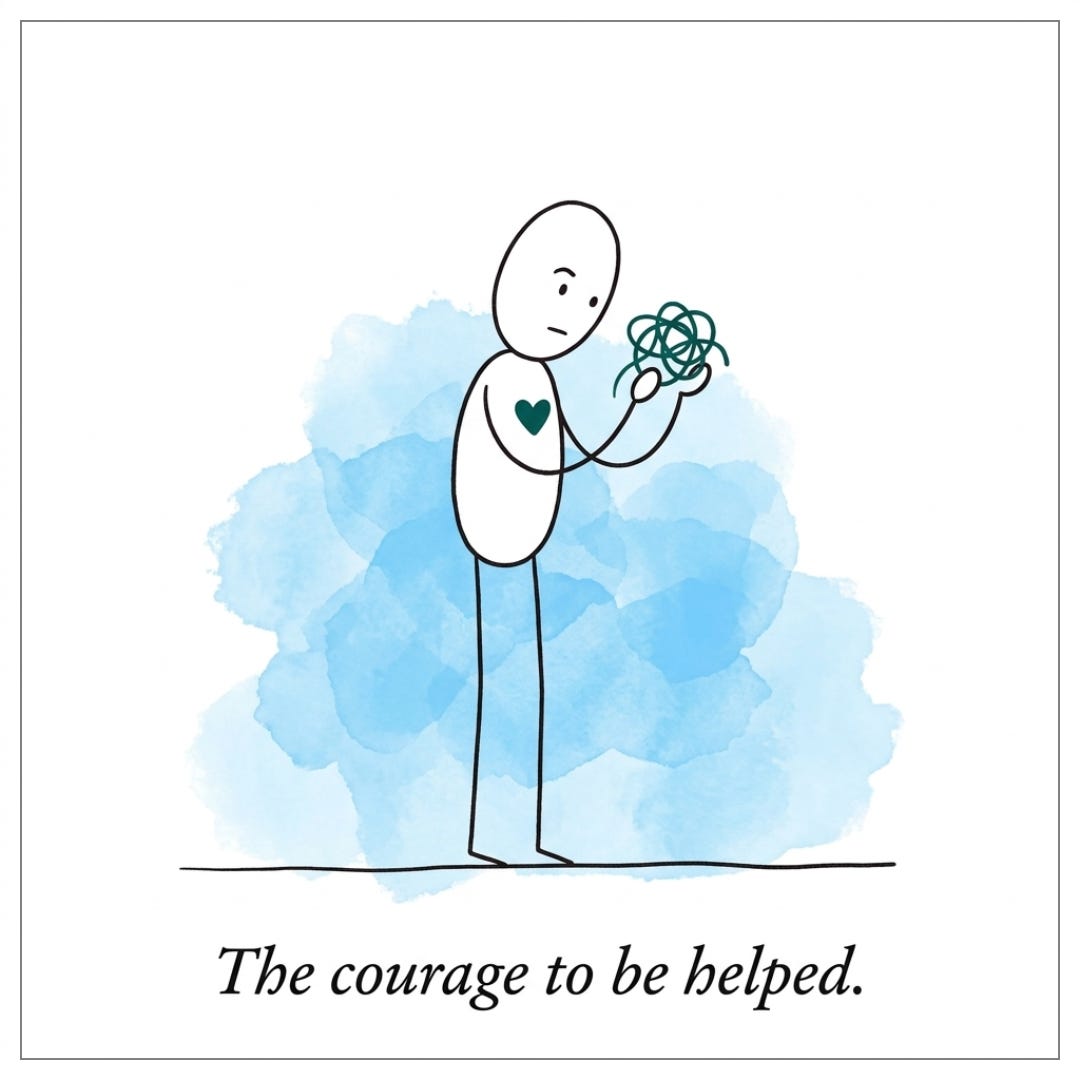
I used to think courage in business mostly looked like taking the leap, making the offer, or being visible.
Now I think one of its forms is knowing when you have reached the edge of your own perspective.
This does not mean handing your discernment to the next person with a polished sales page. There are good reasons people have trust issues around the business-advice industry.
It means finding someone whose thinking you respect and becoming willing to discover what you cannot see from inside your own patterns.
It might be a mentor. A skilled colleague. A clear diagnostic. Sometimes it is a customer who tells you, in one sentence, why the offer you spent three months perfecting makes no sense to them.
The source matters less than the willingness to receive the signal.
Because there is a real cost to carrying every question alone.
It is not only the money you may fail to earn. It is the two years spent going in circles. The energy drained by trying to take five directions all at once. The slow erosion of confidence that happens when effort keeps producing no useful evidence.
Eventually, a fixable blind spot begins to feel like fate.
And that is the part that breaks my heart.
Not everyone needs a coach. Not every business should continue. And going back to a job can be an intelligent, self-honoring choice.
I simply do not want gifted people abandoning meaningful work because they were diagnosing the wrong problem.
The work might be right.
The friction might be somewhere else.
And seeing that clearly could change what becomes possible next.
See what is actually creating the friction
If you have done substantial inner work and still wonder why the business feels harder than it should, the Sacred Business Harmony Map Assessment™ was made to help you see the pattern more clearly.
It is a free, eight-minute assessment that looks at the relationship between you, your business, and the deeper work that is asking to move through you.
It will not hand you a magical answer. It will help you stop guessing, identify where things are getting tangled, and see where your attention may belong next.
So if you want to move your deeper work forward without spending another year questioning the gift or piecing together random advice, begin here:
Take the Free Harmony Map Assessment →
See the pattern. Find the friction. Make the next move from there.

One thing you can be sure of, I am definitely not going back to employment!
That said, I am not ready to retire either. Here to stay 👍💕
Portuguese! That's what's holding me back! I need more language acquisition to truly fulfill the vision of what I want to do here in my retirement in Portugal, but I can't let that hold me back more than it really should. I'm doing something completely new to me (retired theatre teacher), but it feels right! If I were going to start a theatre program, I would know exactly what to do and wouldn't have to think much at all! Now, all I'm doing is thinking and second guessing!