



Someone whose perspective on business and life I’ve been appreciating lately is Jonathan Goodman .
Jonathan built a fitness education business and has trained over 65,000 professionals. But what makes him worth reading isn’t his credentials. It’s his argument against the advice you’ve heard a hundred times that all you need are small consistent improvements – and how this might be working against how you’re actually wired.
He sent Carolina Wilke and me an advanced copy of his new book, Unhinged Habits, and I’ve been enjoying it. Thank you, Jonathan.
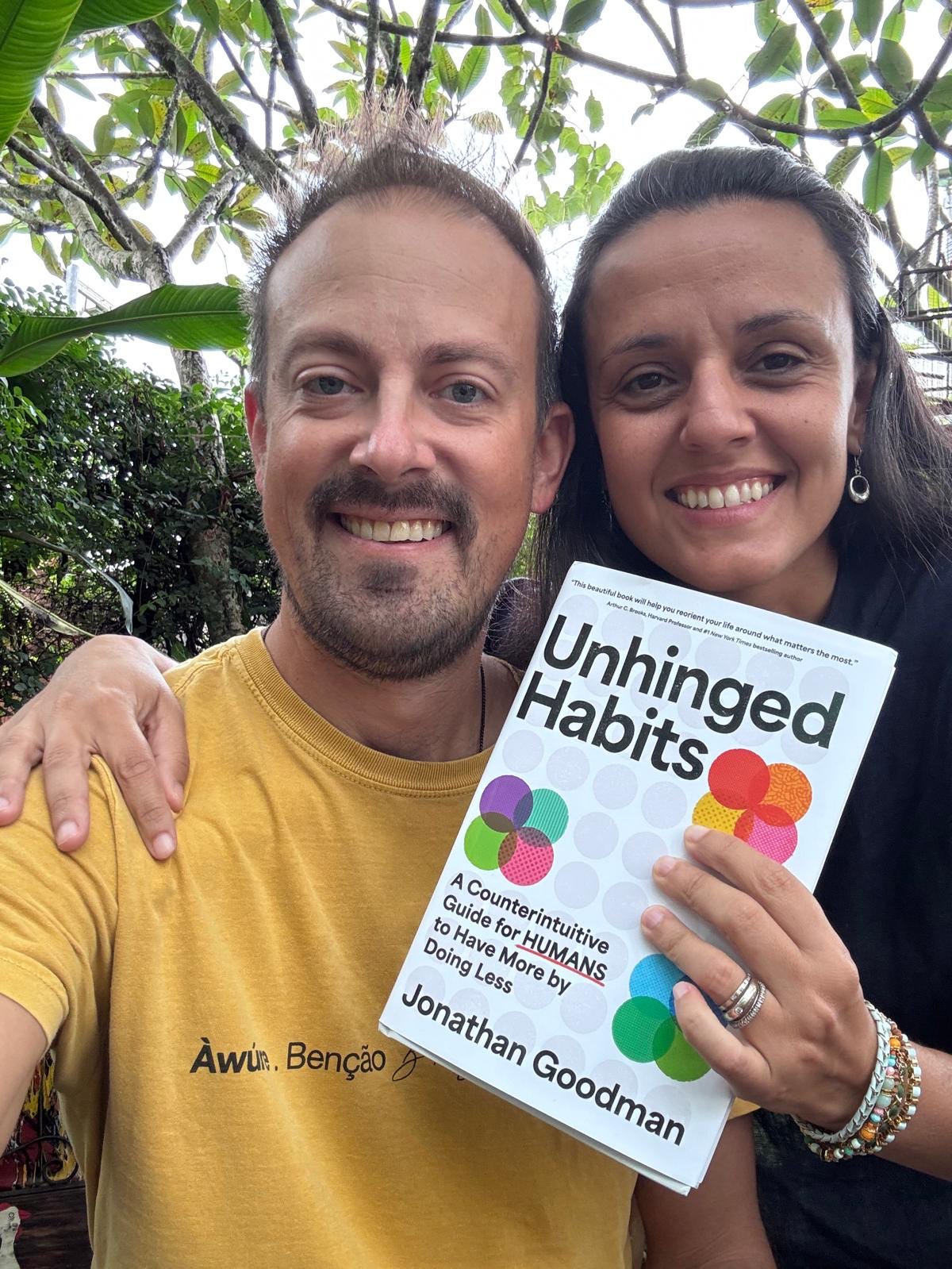
Here’s why I wanted to share this with you.
Most of us have been sold on the math of slow, steady improvement. Stack habits. Push 1% harder each day. Trust the exponential curve. It sounds right on paper.
But if you’re honest, you’ve probably tried this. And you’ve probably felt it fail in certain moments. Not because you lack discipline. Because your brain wasn’t built for as he calls it, “marginal gains and blind faith in some nebulous future payoff”.
Jonathan calls this out directly. And he offers a different frame.
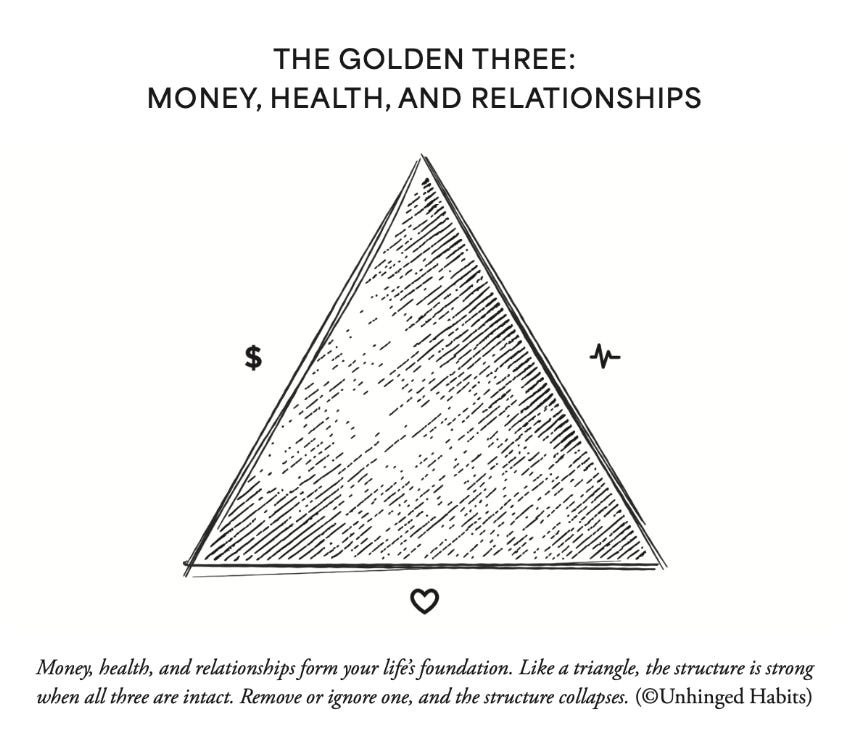
He presents life as a triangle with three competing priorities: Money. Health. Relationships. The goal isn’t perfect balance. It’s thickening each side, one at a time, through seasons of intensity, without letting the structure collapse.
His take on intensity versus consistency landed for me:
Let’s start with life’s three competing priorities:
1. Money.
2. Health.
3. Relationships.
Consider each priority a side of a triangle. Together, the structure’s strong. Ignore one side, and it collapses.
The process of betterment is the process of thickening your triangle, one line at a time, without collapsing the structure.
Most adults stop evolving once they reach adulthood. They never learn anything new, meaningfully improve their health, or build deep and fulfilling relationships.
Mathematically, the idea of slow gains brought on by stacking habits over time is exponentially positive. And that checks out. The curve is up and to the right, accelerating over time.
Life isn’t math. Our brains aren’t calculators. Not mine, anyway. Intellectually knowing that something theoretically works is different from living its experience every day.
I’m not able to push a little bit harder every day. I don’t even know what that means. On what am I supposed to be improving slowly on? Everything? One thing at a time? And then what, I’m supposed to have blind faith that what I’m doing is going to pay off at some point in the nebulous future, whenever the imaginary curve that governs my life decides to hit an inflection point?
Hope is an opiate, not a plan. That’s too much blind faith. Too many unknowns. Even if we are going to make a mathematical argument, I know one thing for certain: the only way to solve any complex problem is to begin with the known integer.
For better or for worse, my human brain craves novelty and excitement and immediate gratification. Maybe I’m not strong willed enough to overcome thousands of years of evolutionary physiology. Maybe my mind is naturally weaker than others. If so, it is what it is. Regardless, it’s up to me to work with the physiology that I’ve got.
Transformational change doesn’t come about as a result of slow and marginal gains over time. It happens as a result of intensity. Of obsession.
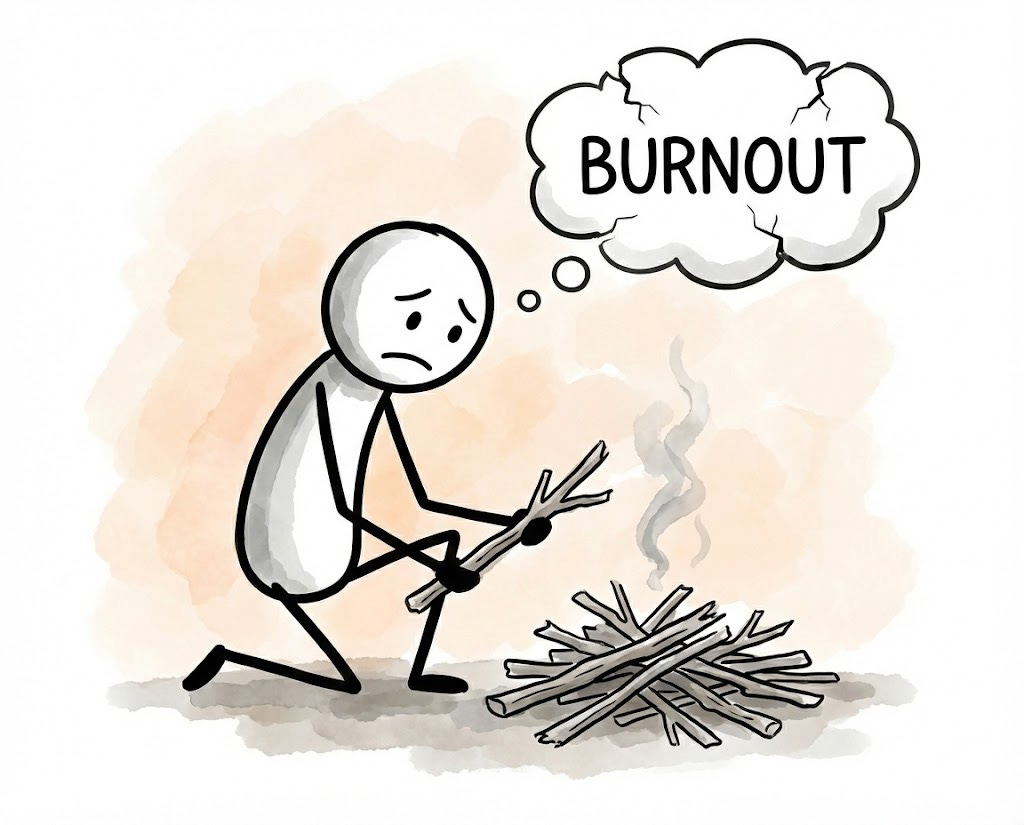
The daily efforts––which I call the in-between things––fuel the main thing. But spending all of your time on the in-between things and never focusing on the main thing results in a lot of sticks and no fire. People call this burnout. I’ve never liked that term. There was never a flame in the first place.
Visually, think of it like this: whenever you’re in a season of obsession on one thing, that side is thickening while the other sides are being maintained. And because each season has a priority and focus, it stays fun, fresh, and exciting.
With each season your old ceilings will become your new floors, continually circling each element at a higher level. A lightning strike permanently impacting the landscape versus a series of unimpactful sparks.
Whatever it is you want to excel at, whether it’s your career, your family, your fitness level, a personal passion, your social life––anything!––define it and prioritize it by placing it at the top of your to-do list.
It’s unhinged, almost deranged, this type of maniacal focus.
None of this is likely sustainable long term both financially or temporally. That’s fine. It doesn’t need to be.
It’s not possible to be in-season all the time. You might sometimes have everything on cruise control, too, which is fine.
Long-term consistency and stacking habits is a great way to make sure you do stuff like floss your teeth more often. But without intensity (visits to the dentist), you’ll never earn a pearly white smile.
Intensity is for gaining. Consistency is for maintaining. You can’t have one without the other.
This line really resonated with me: “There was never a flame in the first place.”
I’ve built three businesses now. My hearing consulting business. Empire Engineering. Sacred Business Flow. And every single one required what I think of as rocket fuel energy to get into the atmosphere.
Someone in our Serve & Receive course asked me recently about my first $2,500/month client. How many hours was I putting in? The honest answer: probably 3-5 times longer than the work itself required. Because I wasn’t just serving the client. I was building the system so I’d never have to do the same thing twice.
That season was intense. There were days I hit the pillow tired. And days that I still do. But its usually a good tired. The kind that comes when you know exactly where you’re going and why you’re going there.
Here’s what I want you to hear: that intensity didn’t burn me out. It built something that now runs while I’m hiking to Machu Picchu or visiting with tribes in the Amazon.
The difference between burning out and burning bright isn’t the number of hours. It’s the energy behind them.
Burnout comes from frantic buckshot. You don’t know what to do, so you burn all ends of the candle hoping something works. That’s scarcity energy. It can’t sustain.
Burning bright comes from a full-body yes. Conviction. Clarity. Total alignment with where you’re going. That energy can sustain longer hours and harder months because your heart knows the destination. And it knows when to shift back.
I think so many of you are afraid of intensity because you’ve confused it with the frantic version. You hold back to protect yourself from burnout. But you end up with what Jonathan describes: lots of sticks, no fire.
The rocket fuel season doesn’t last forever. For me, it’s usually about 90 days. Then you shift into maintenance. Your old ceiling becomes your new floor. And eventually, another season of intensity comes when it’s time to build the next thing.
Jonathan’s framework gave me language for something I’ve been living but hadn’t fully articulated. That’s why I wanted to share it with you.
Check out the full book at unhingedhabits.com or buy a copy on Amazon or wherever you buy books.
Hi Phil, "The difference between burning out and burning bright isn’t the number of hours. It’s the energy behind them." Well said.
I understand triangle metaphor that you summarize. It's interesting. Yet, I lean toward a pyramid, with health as the foundation of everything else while we live in these bodies bound by gravity. But because everything is related, biofields intersecting with biofields, a "circle" works the best for me. A circle of care. Who and what is in your circle of care? What are the energies there?
Can you draw that? :)
Dawn really is the most underrated reset button.
Yesterday has a loud voice - it loves to narrate what you “should’ve” done.
But morning doesn’t ask for a resume. It just hands you a clean page.
And I love the reminder here: transformation isn’t always dramatic.
Sometimes it’s one small, present choice - a breath, a pause, a quiet “not today” to what drains you.
That’s how a new life starts.
Not all at once.
But right now.