


A lot of conversations about visibility focus on audience size, algorithms, or posting frequency. Those things matter, but they’re rarely the actual reason people hesitate to show up online.
The harder part is much more personal.
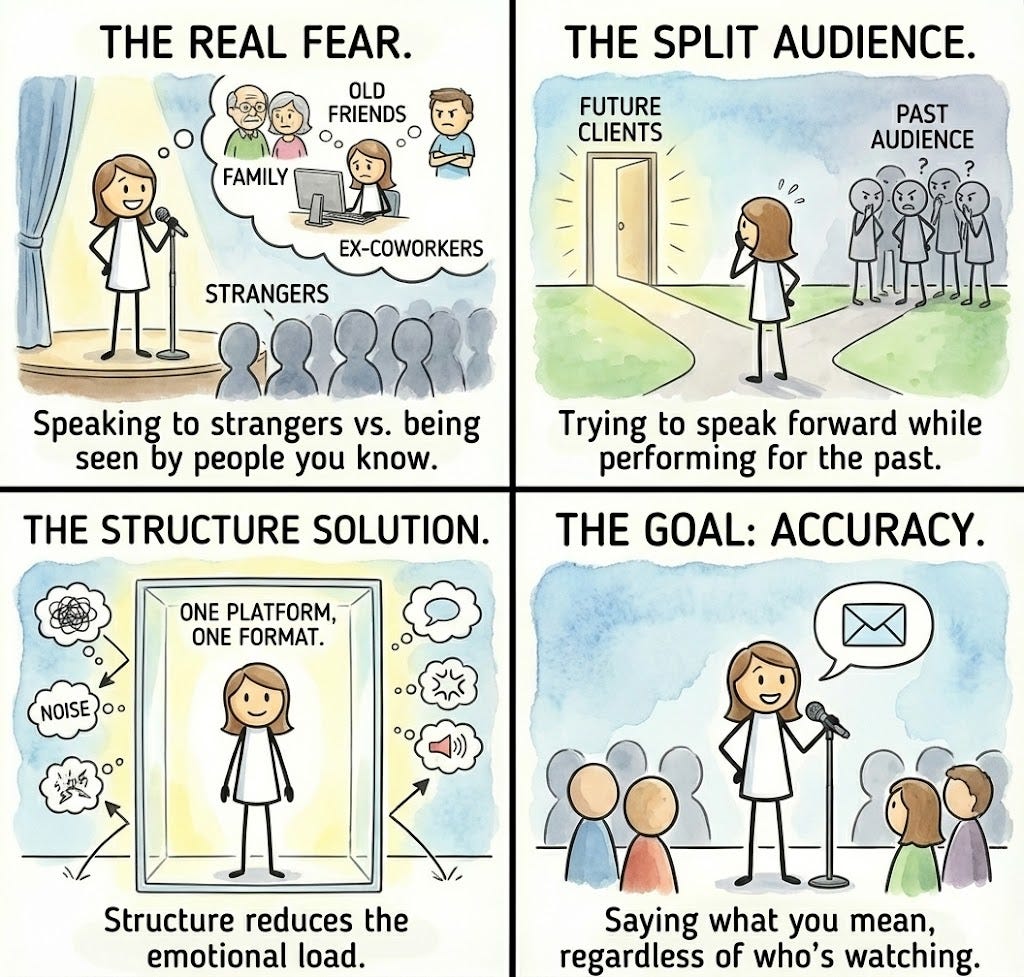
I was talking with someone recently who said she had no problem speaking to people in real life. But when she tried posting on Instagram, she froze. Not because she worried about strangers. Strangers were fine. It was the people who already knew her that made her pause.
She wasn’t worried about going viral. She was worried about being seen by the wrong audience: family, long-time friends, former coworkers. People who had a very fixed sense of who she was and how she was “supposed” to show up.
This is a more common issue than people admit.
When you’ve lived a certain way for a long time — or been perceived a certain way — sharing a different side of yourself feels less like marketing and more like disruption. Even if the new direction is honest, it still collides with old expectations.
And that conflict makes visibility confusing.
You’re not just dealing with content strategy.
You’re dealing with identity, memory, and history — yours and other people’s.
Posting becomes less about the message and more about managing reactions you can’t control.
No amount of “post consistently” advice solves that.
For the woman I spoke with, the fear wasn’t abstract. She knew exactly who she imagined when she typed something vulnerable: a relative who comments on everything, an old friend who has an opinion about every life choice she’s made, a colleague who would quietly judge the shift in her career.
Those imagined reactions shaped her content more than any algorithm.
And this is where people get stuck.
They’re trying to speak to future clients while mentally performing for past audiences.
It’s a split that makes every sentence harder than it needs to be.
Visibility becomes something to brace for, rather than something to step into.
If you strip away the fear of strangers, what’s left is often very specific:
• not wanting to be misunderstood by people who knew a former version of you
• not wanting your work taken out of context
• not wanting to deal with personal commentary disguised as concern
• not wanting to trigger conversations you don’t want to have offline
• not wanting to look like you’re “trying something” in front of people who never tried anything
These aren’t irrational concerns. They’re practical ones.
And they shape how you show up far more than follower count ever will.
For most people, the challenge isn’t hitting “post.”
It’s accepting that visibility comes with a certain amount of misinterpretation — sometimes from the exact people whose approval used to matter.
This is where structure helps.
Not complicated systems — just enough clarity to reduce the emotional load.
Choosing one platform and one format gives you boundaries.
It narrows the arena.
It creates consistency without requiring you to be emotionally brave every single time.
Once the container is predictable, the internal noise quiets down.
Not completely, but enough to let your actual perspective come through, instead of the heavily edited version meant to satisfy everyone who might see it.
Over time, visibility becomes less about performance and more about accuracy:
saying what you mean in a way you can stand behind, regardless of who’s watching.
And even then, the line between “this feels like me” and “this feels like too much” isn’t fixed. It moves. It depends on context, timing, and capacity.
I don’t think there’s a perfect formula for where that line sits.
It’s something most people figure out gradually, by noticing what feels sustainable and what doesn’t.
Which makes me curious:
How do you decide what version of yourself you’re willing to make public — and what stays private?
Where is that line for you?
Want to go deeper?
Here’s how we can help you get clear, get visible, and get clients:
Take the Harmony Map Assessment (Free): Find out which pattern is blocking your clarity, visibility, or ability to get the right clients. 8 minutes. You’ll see exactly what’s been in the way, and why strategy alone hasn’t fixed it.
Read the Sacred Business Manifesto (Free): The full philosophy behind how we work, why inner patterns create outer business challenges, and what it means to build from both sides.