


Last week, one of our newer clients told me she felt discouraged.
She had launched an offer to her list of 62 subscribers and made one sale.
To her, it felt like failure.
But one sale from 62 people is a 1.6% conversion rate.
For a newer creator, that is not bad news.
That is signal.
That is the beginning of traction.
And this is also where so many people lose the plot.
Not because the the quality of their work is bad
Not because the offer is wrong.
But because they do not yet have the right scoreboard.
They often measure early movement against someone else’s visible success, without seeing the invisible backstory:
the ten-year career behind the audience
the old list behind the “overnight” Substack growth
the ad spend behind the polished launch
the years of trust that got compressed into one visible moment
So they make one dangerous mistake:
They read what feels like a small result as proof that something is wrong, instead of seeing it for what it really is.
Usually, it is not something gone “wrong”.
Usually, it means you are much closer than you think.
The real issue is not always the launch. It’s the model.
A small launch can still be a strong launch.
But it may also reveal something important:
you might need a different business model, not more self-doubt.
This is the math nobody explains.
If you are trying to build a sustainable business on low-ticket offers alone, you need a lot of volume. Usually far more than early-stage creators realize.
That does not mean your offer failed.
It means the structure may need to evolve.
And that is actually good news.
Because if your work is creating real resonance, you do not need to chase a giant audience first.
You may need:
a clearer path
a stronger offer model
and a business structure that can support your life while you grow
That is a much more hopeful problem to solve.
If you’re wondering, “Okay, but how do I know what the real problem actually is?” - that’s exactly what we unpack in this week’s private podcast.
Watch the full interview →
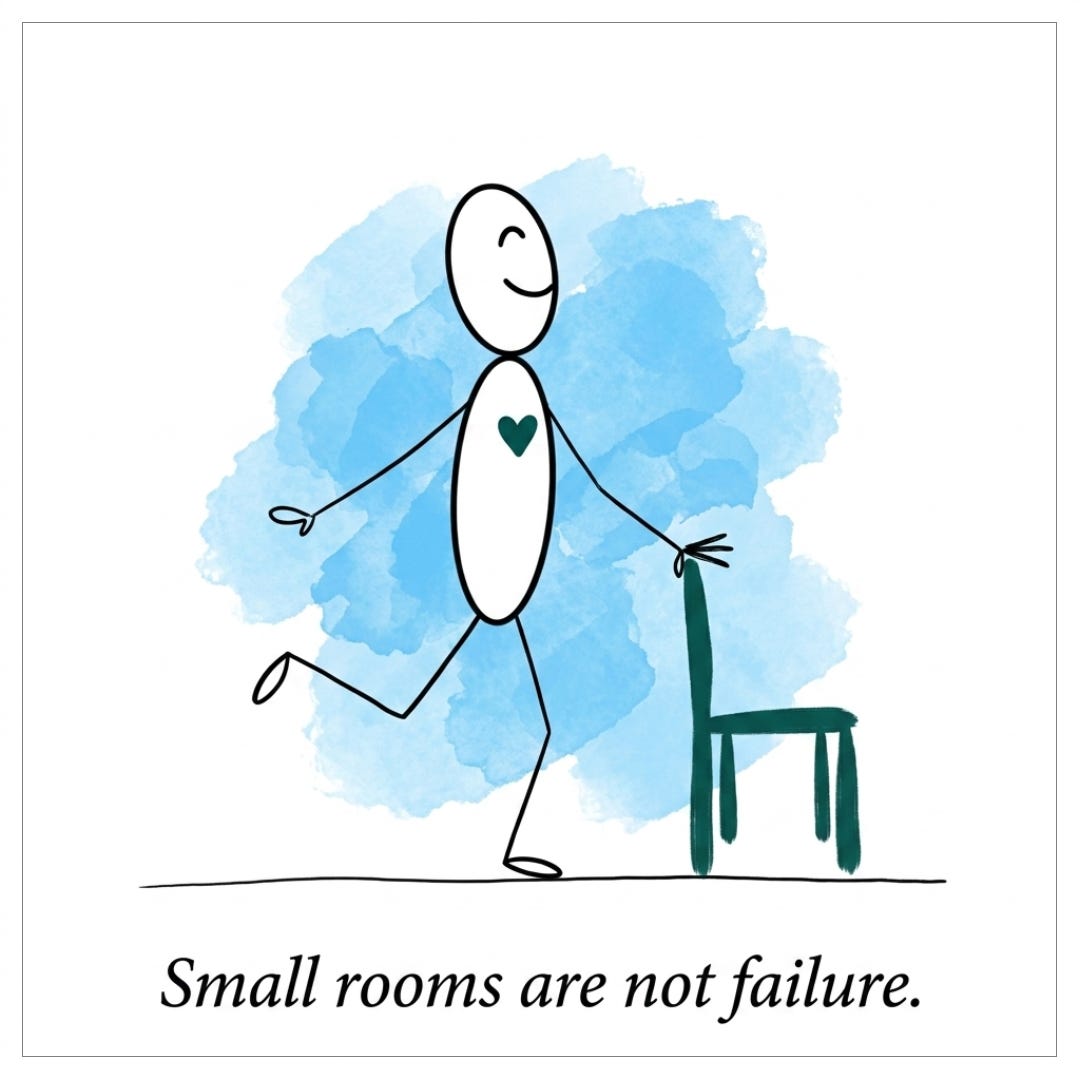
Small rooms are not failure
There is also a fear almost nobody talks about:
What if only a few people say yes?
People imagine the awkward Zoom room.
The tiny group.
The visible proof that they are “not there yet.”
But small rooms are often where the best work happens.
More intimacy.
More attention.
More transformation.
More truth.
One of the most powerful ideas Carolina brought into her first business was what she calls the Power of One:
One more client.
One more subscriber.
One more person on the call.
That is not small thinking.
That is how great businesses are built.
The good news
The good news is this:
You do not need to win the volume game first to build something successful.
If the work is resonating, if people are saying yes, if transformation is happening, you may not be failing at all.
You may simply be standing at the point where your business needs a model that can hold your depth.
That is exactly why we implement the Inverted Pyramid inside Serve and Receive with many of our clients.
Instead of trying to build from the bottom up with cheap offers and exhausting volume, you build a strong base first:
fewer people
deeper transformation
better economics
more breathing room
and a business that can actually support your life as it grows
That is not a compromise.
That is often the simpler, saner, more sustainable path.
Before you call your launch a failure, ask:
Is this actually a bad result, or just a small one?
Is the offer resonating?
Is the conversion healthy for my stage of business?
Am I trying to solve a business-model problem with more effort?
What if this result is pointing me toward a better structure, not away from the work?
That is the conversation that matters.
Because sometimes a “failed” launch is not failure at all.
Sometimes its actually the first piece of evidence that your work is taking hold, and that it is time to build the right business around it.
If this essay has you wondering whether the real problem is your offer, your audience, your invitations, or simply the way you are measuring progress, the conversation Phil and I had today goes much deeper.
We unpack the three places a business usually gets stuck, why a “disguised invitation” is not an invitation, the difference between doing the job and building the business, and the simple numbers that reveal what actually needs your attention next.
Upgrade to paid to watch the full replay.
You might be working on the wrong problem

Episode 002 of Sitting on a Bench explored a question that can save you months of effort: