


A pattern shows up among a certain kind of entrepreneur: they want a business built on intuition. They want to make decisions by feel, follow their impulses, and stay far away from anything that resembles a formula. The hope is that if they trust themselves enough, the business will grow in a way that feels natural.
That’s an understandable preference. But in practice, it often doesn’t work.
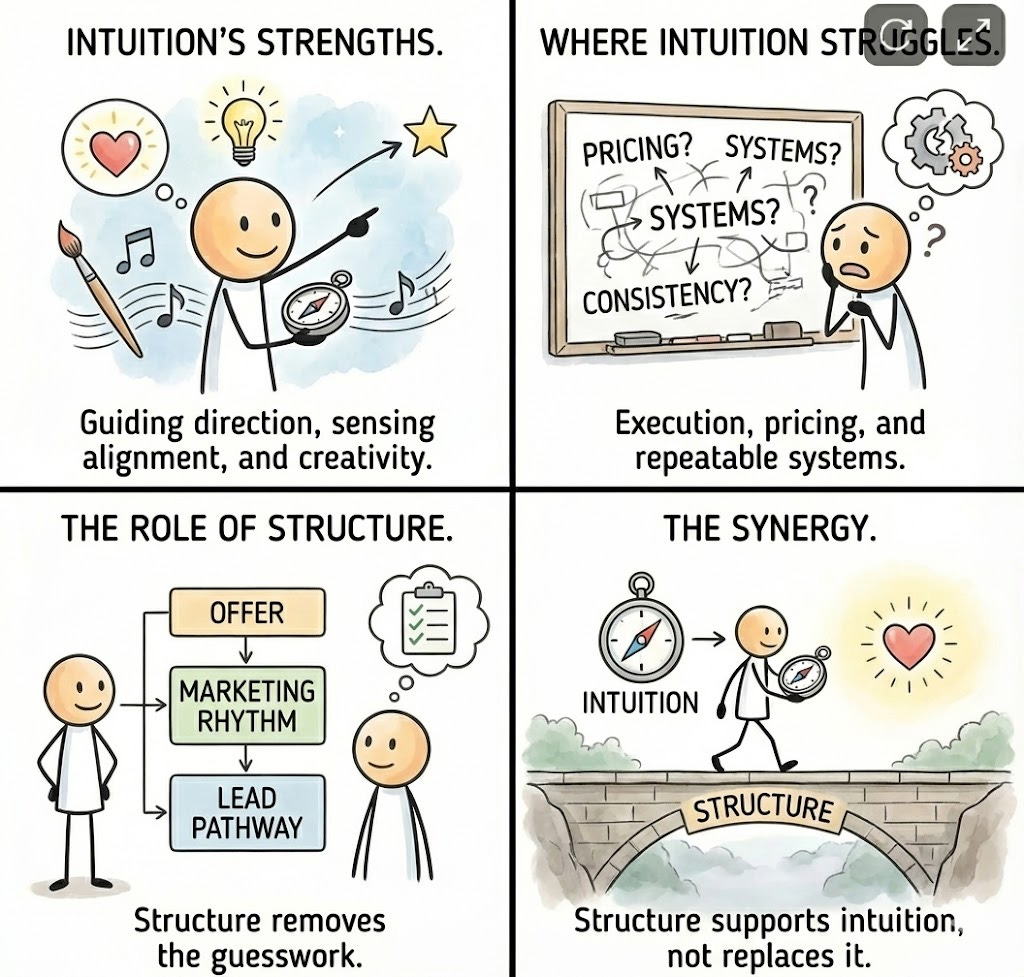
I was talking with someone recently who fit this pattern. She’s bright, perceptive, and clearly good at what she does. She gets strong ideas. She reads people well. She doesn’t need a script to help someone. None of that is in question.
The problem was her plan.
She wanted:
• minimal hours
• intuitive marketing
• clients who “just find me”
• ads she’d eventually figure out
• landing pages she’d build herself
• a loose, flexible offer
• and a business that unfolded without much structure
Nothing wrong with wanting ease. But after several months, her results didn’t match the effort she was putting in. She wasn’t lazy. She wasn’t confused. She was simply trying to build a business using only one tool — intuition — in situations where intuition isn’t well-suited.
And that’s a bigger issue than most people realize.
My own experience wasn’t that different
After my 100K a month business that I often talk about crashed and burned, I resisted structure. Not dramatically — but I was refusing to commit to anything too defined. I wanted everything to stay open. I told myself I’d know the right next step when I felt it. Sometimes that worked. Often it didn’t.
The pattern became obvious only in hindsight:
intuition helped with direction, but not with execution.
It didn’t give me:
• pricing
• timelines
• marketing sequences
• predictable lead flow
• consistent output
• or a repeatable client pathway
These weren’t “alignment issues.” They were simply things intuition isn’t designed to handle. I eventually had to get back to the unglamorous side of business: sequencing, systems, structure, and consistency.
That’s when things stabilized.
Not because I became less intuitive — but because intuition stopped carrying the weight of tasks it was never meant to manage.
Why intuitive founders get stuck (without psychologizing it)
There are a few simple, practical reasons this happens. None of them require talk about identity, wounds, or subconscious blocks.
1. They want to avoid rigid environments
Often because they’ve experienced them before. So they default to the opposite extreme: too much openness, not enough definition.
2. They equate structure with sameness
There’s an assumption that using structure automatically makes them generic. It doesn’t, but it can feel that way from the outside.
3. They assume intuition can fill operational gaps
Intuition is great for sensing what matters. It’s not great for designing systems.
4. They underestimate the skill sets required
Marketing, messaging, offer design, pricing, and client acquisition are all disciplines. Not moral tests. Not spiritual measures. Just skills.
5. They try to be all departments at once
Vision, delivery, messaging, marketing, operations. It’s simply too many hats. Most people burn out from the load, not the work.
None of this means intuitive people are “blocked.” It just means they’re over-relying on one strength and underutilizing tools that would make their lives easier.
What intuition is good for
Intuition helps with:
• sensing direction
• shaping the tone of an offer
• understanding clients
• feeling when something is off
• making creative decisions
• guiding the work itself
These are real strengths.
But intuition struggles with:
• consistent output
• pricing based on value instead of mood
• marketing systems
• long-term planning
• lead flow
• repeatable processes
• execution at scale
This isn’t criticism. It’s basic practicality.
No one, intuitive or not, can build a sustainable business on feel alone.
Where structure becomes necessary (and much simpler than people assume)
When I work with intuitive founders, the solutions are never complicated. They’re almost always some combination of:
Defining a primary offer
Something someone can understand without needing to decode it.Choosing one main visibility channel
Not five. One.Creating a predictable marketing rhythm
Weekly email, weekly post, something consistent.A simple lead pathway
Nothing heavy. Often something like:
free resource → short nurture sequence → invitation to the main offer.Clear criteria for new ideas
Not every download becomes a project. Most need parking, not building.Using AI in a focused way
To draft, organize, refine, or repurpose — not to make strategic decisions.
None of this interferes with intuition.
It removes the clutter so intuition can be used where it’s actually helpful.
What people fear — and what’s actually true
Intuitive entrepreneurs often worry that structure will flatten their voice or make them formulaic. In practice, the opposite happens.
When the administrative and operational parts of the business stop requiring improvisation, there’s more room for the work itself. Creativity increases, not decreases. There’s less pressure, not more. And the quality of attention improves because the environment isn’t chaotic.
Nothing about structure requires abandoning instinct.
It simply prevents instinct from doing chores it’s not suited for.
No tidy moral of the story
Every business requires some balance of intuition and structure. The proportions differ for each person. Some can get by with very little structure. Others need more. There’s no universal rule.
The key point is just this:
Intuition works best when it isn’t being asked to run the whole business.
And structure works best when it isn’t treated as a threat.
Somewhere between those two lies the version of your business that’s actually sustainable.
So here’s the real question:
Where does intuition genuinely help you — and where does it make things harder than they need to be?
Want to go deeper?
Here’s how we can help you get clear, get visible, and get clients:
Take the Harmony Map Assessment (Free): Find out which pattern is blocking your clarity, visibility, or ability to get the right clients. 8 minutes. You’ll see exactly what’s been in the way, and why strategy alone hasn’t fixed it.
Read the Sacred Business Manifesto (Free): The full philosophy behind how we work, why inner patterns create outer business challenges, and what it means to build from both sides.
Totally agree about the part of avoiding rigid environments. As an entrepreneur something I’ve found helpful is leveraging my intuition to create repeatable support systems so I don’t feel boxed in yet it makes space for intuition downloads to land
I think I needed to hear this today. Thank you for sharing!