


A couple of weeks ago, we ran a flash sale on our paid Substack membership.
Here is the mildly embarrassing reason: we had slipped below the threshold for our bestseller badge, and we wanted it back.
I like the badge. It gives us early access to certain features, and it offers a small signal of trust. People see it and know that others value what we create here.
Still, I think creators are asking that badge to mean far more than it does.
You become a Substack bestseller when you reach 100 paid subscribers.
That is worth celebrating. I have watched several friends earn theirs recently, and I was genuinely happy for them. It feels exciting because it represents 100 people choosing to support your work.
It does not mean you have built a sustainable business.
The short answer: Yes, a paid Substack can replace a salary, but the audience requirement is larger than most creators expect. At $15 a month, replacing a $5,000 monthly salary requires 334 paid subscribers before fees, taxes, and cancellations. Depending on whether 3% or 0.5% of your free subscribers convert, that may require roughly 11,000 to 66,800 free subscribers.
As of September 2026, our paid Substack brings in roughly $10,000 a year.
Some members joined at our current annual price of $149. Others came through early discounts or birthday promotions, and some were originally comped because they belonged to our other memberships before we ever planned to build a paid publication.
We are in the expansion phase of a multiple six-figure business. Substack subscriptions make up a tiny fraction of that revenue.
Substack helps people discover us, and our essays build trust. The paid publication gives us a beautiful place to share private podcasts and spend more time with the people who want to go deeper.
I value all of that.
But here is something you might not expect: of all the people we serve, our paid Substack subscribers are often the least engaged. Another publication may have a very different experience. For us, paying for more content has not created the same depth of connection as doing real work together.
If we had asked paid subscriptions to sustain the business, we would be in trouble. The problem begins when you ask an audience-building platform to carry the full weight of your business model.
How many paid Substack subscribers does it take to replace a salary?
Let us say you charge $15 a month and want to replace a $5,000 monthly salary.
The basic gross-income formula is:
Desired monthly income ÷ monthly subscription price = paid subscribers needed
To estimate the audience behind those subscribers:
Paid subscribers needed ÷ free-to-paid conversion rate = free subscribers needed
You need 334 paid subscribers to gross $5,000 a month. That is before fees, taxes, cancellations, and the steady work of replacing people who leave.
Now assume a healthy 3% of your free subscribers eventually convert to paid. You would need more than 11,000 free subscribers to reach 334 paid.
At 0.5%, you would need 66,800.
Your free-to-paid conversion rate is the percentage of free subscribers who eventually become paying subscribers. It is not a universal constant. Your niche, price, existing authority, reader loyalty, and what you offer paid members can all change it over time.
That lower estimate may sound grim. Chanti Zak recently wrote an excellent email called I Think We’re Lying About What It Takes. She shared that, without a proven benchmark of her own, she now plans around a 0.5% conversion rate because the old averages are failing so many smart people.
I appreciated her honesty.
I never want to tell someone that they cannot be the exception. I do want them to understand the conditions required for the plan to work.
Those conditions are getting harder. Most of us already have more subscriptions than we want. Information has never been cheaper, especially now that AI can generate another article, course, or guide in seconds.
People are hungry for connection that leads somewhere. They want help making a decision and putting it into motion.
The same problem appears with small courses.
Suppose you have 1,000 subscribers and launch a $297 course. At 3%, 30 people buy and you make $8,910.
That is a real win. Enjoy it.
Then ask the next question: can you do it again?
Your first launch may have benefited from a year of pent-up demand. Relaunching the same course to largely the same people rarely produces another 30 buyers. The audience has already seen it, some bought, and others decided it was not for them.
To earn $5,000 every month from that course, you need about 17 new sales each month. At a 3% conversion rate, that means reaching roughly 567 qualified prospects every month. At 0.5%, it is closer to 3,400.
A successful launch proves people will buy. A sustainable business proves you can keep reaching enough new buyers.
Why successful Substack creators usually have a hidden runway
Sam Illingworth’s growth with Slow AI has been masterful.
In roughly a year, he grew to more than 16,000 subscribers and nearly 300 paid members. I was deeply impressed by what he created.
It also was not his first rodeo.
Before Slow AI, Sam had spent a decade doing public engagement. He had built a successful blog, hosted a podcast, developed audiences on other platforms, and become a university professor who speaks to tens of thousands of people a year. He is also an award-winning playwright and actor.
What looked like a meteoric rise carried 15 to 20 years of skill underneath it.
Understanding that runway makes Sam’s accomplishment far more useful.
There is another kind of success story you will see on Substack: people with thousands of paid subscribers who teach Substack growth.
Their success may be entirely accurate. They also have a built-in market. They are selling help with the platform to people already gathered on the platform, often after bringing an audience, authority, or proven growth skills from somewhere else.
That does not make the result less impressive. It does make the conditions different.
Paid subscriptions become much more viable when you have at least one of three things: an audience you can bring, a built-in market with active demand, or a long runway to build patiently.
Can people really make a full-time income on Substack?
They do. Look closely at what they sell and where they began.
Many of the people with the largest paid memberships teach Substack growth. They have a built-in market on the platform because thousands of creators are already trying to solve that exact problem. Their own growth becomes proof of what they sell, which creates even more demand for the paid subscription.
Others brought their audience from somewhere else. They arrived with years of attention, trust, and demand already in place.
Both paths are legitimate. They also begin with conditions most new creators do not have.
Someone famous can bring thousands of people with them on day one. A writer with a long runway can patiently build for several years. A person who enjoys their job and wants extra money for travel may find that a small paid publication does exactly what they need.
I am speaking to someone else.
I am speaking to the person who feels meaningful work burning in their heart and wants enough financial freedom to answer the call. They want to serve people, create real change, and build a life around work that feels deeply their own.
For that person, time matters.
Why the slower path can feel safer
There is a reason so many thoughtful people choose to try to sell a $10 subscription first.
You can write behind your computer, publish, and wait. You never have to look someone in the eye and say, “I believe this can help you. Would you like to do this together?”
A deeper offer asks more of you.
You have to talk with people. You need to make personal invitations and find a way to sell that feels authentic. Someone may say no, and your body may interpret that no as rejection of something very close to your identity.
The $10 subscription gives you a smaller distance to fall.
The danger is what happens when you keep publishing and almost nobody buys.
You start thinking, “If I cannot sell this for $10, how could I ever sell something for $2,000?”
That interpretation can drain your confidence. Some people spend a year or two following a model that never had the economics to support them, then decide nobody wants their work.
Employment may have been the wisest choice for them. What stayed with me was the possibility that they left believing the work had failed when the structure around it never had a fair chance.
That is why the math matters.
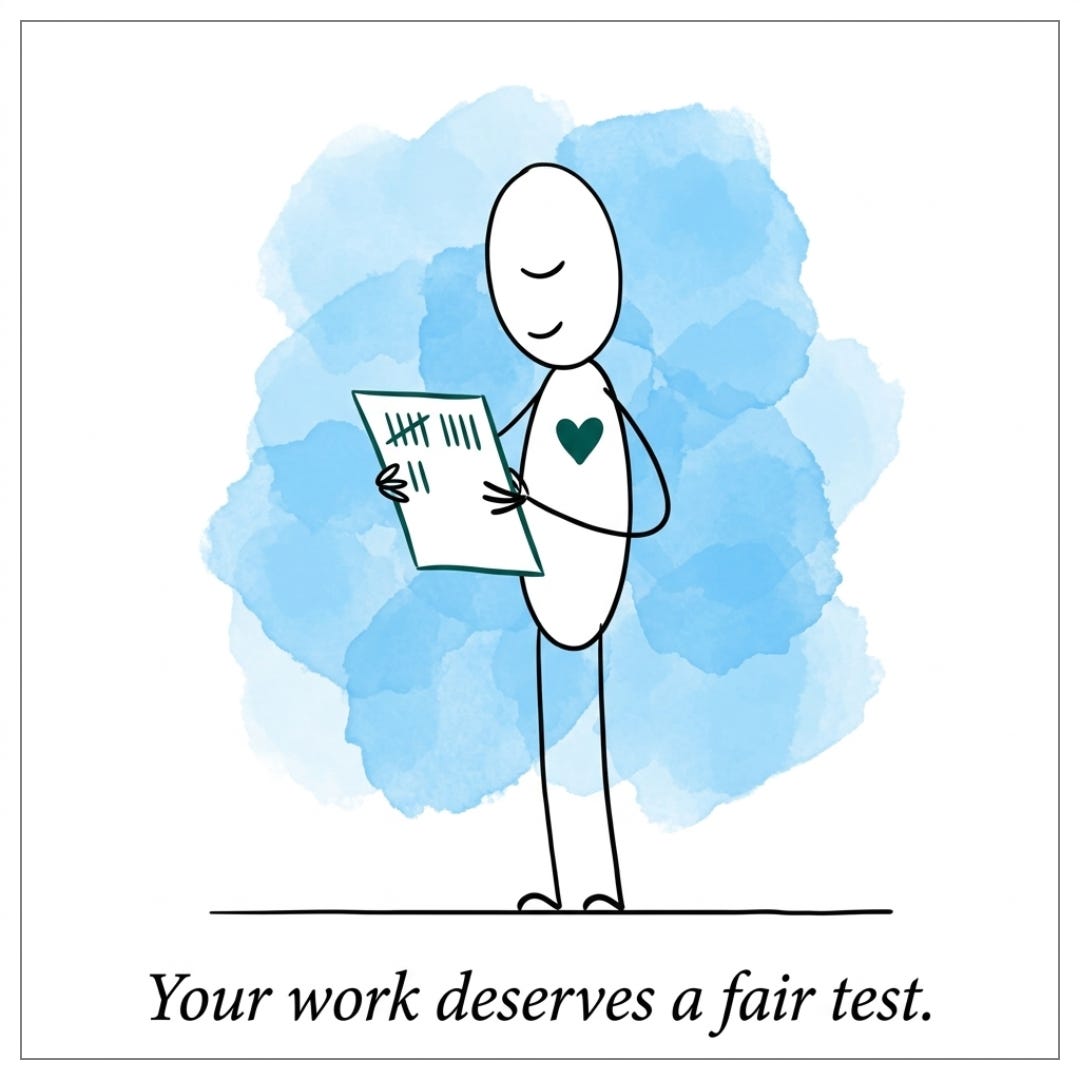
Your work deserves a fair test.
Build close to the work first
Inside our paid publication, we teach a model called the Inverted Pyramid.
You begin with a small number of deeper, higher-value client relationships. For many people with a service-based body of work, an offer between $1,500 and $2,000 is a practical place to begin. It can create meaningful value for the client and meaningful revenue for the business without requiring a huge audience.
Three clients at $1,800 create $5,400.
You could also sell ten places in a $500 group and make $5,000. In practice, getting three strong yeses can be easier than finding ten new buyers every month. A lower price does not automatically create an easier sale.
The money creates breathing room, and the value runs much deeper.
Those first clients teach you the language of the people you are here to serve. You hear how they describe the problem before they know your framework. You discover what they have already tried, where they become afraid, and which parts of your work actually create movement.
You get good at solving real problems with real people.
That becomes the wellspring for everything you may create later.
Your conversations inform your writing. Repeated problems may become a group program, and the parts people can use on their own can become a course. Eventually, a membership has a clear role because you built it from lived demand rather than your own intellectual guesses.
You can scale downward as the audience, proof, language, and infrastructure grow.
Private work can become a smaller part of the business as your infrastructure grows. Carolina and I are making that move now. I also expect I will always work closely with some people because that is the heart of this work. It keeps me near what matters.
For those of us who love people and care about meaningful transformation, closeness is part of the freedom we wanted.
How to calculate whether a paid Substack can support you
Keep paid subscriptions if they serve your larger vision. Turn them on, experiment, and let people support your work. Allow the publication to become one valuable part of a larger whole.
Just know your numbers.
Go into Substack and find your average number of new subscribers per month. Choose a conversion estimate grounded in your actual results. Then calculate how many paid subscribers you would need to create the income you want and how long your current growth rate makes that likely to take.
Do the same with your courses, groups, and deeper offers.
Use our free Launch Reality Calculator if you want help running the numbers. Do not take my word for any of this. Put your own audience, price, conversion rate, and income goal into the calculator and let the math show you what the model requires.
Numbers help you decide what to build with your eyes open.
And if the math reveals a deeper conflict between what you want, what you trust yourself to offer, and the work you feel called to pursue, take the free Harmony Map Assessment.
It will help you look at the convergence of clarity, confidence, and purpose, then see where the real friction may be.
A paid Substack can become meaningful income. But replacing a salary usually requires a substantial audience, unusually strong conversion, premium pricing, or years of trust and authority built elsewhere. For many service-based creators, starting with a small number of deeper client relationships creates a faster and more forgiving path.
Keep the dream. Let clearer math help you build a path that gives your deeper work a genuine chance to support your life.

Love that you're speaking to this! Love the transparency and running the numbers.
And love that you told me the same thing when I was just getting off the curb over here.
The math has to math. And the conditions are way, way different than they were for everybody. We're all figuring out what that means.
Also: love even *seeing* this topic in the feed, amid a sea of "Here's How I Got The Bestseller Badge." I think this is the only article of its kind that I've spotted in 5 months of being here.
This is why I trust you and Carolina 💕