


You Can’t Download Your Way Into a Business
A pattern I see often and lived through myself goes something like this:
You get a strong idea. It feels important, maybe even urgent. You build the outline, the offer, maybe even the landing page. For a moment, the whole thing feels inevitable.
Then, as soon as it’s time to move it into the world, everything stalls.
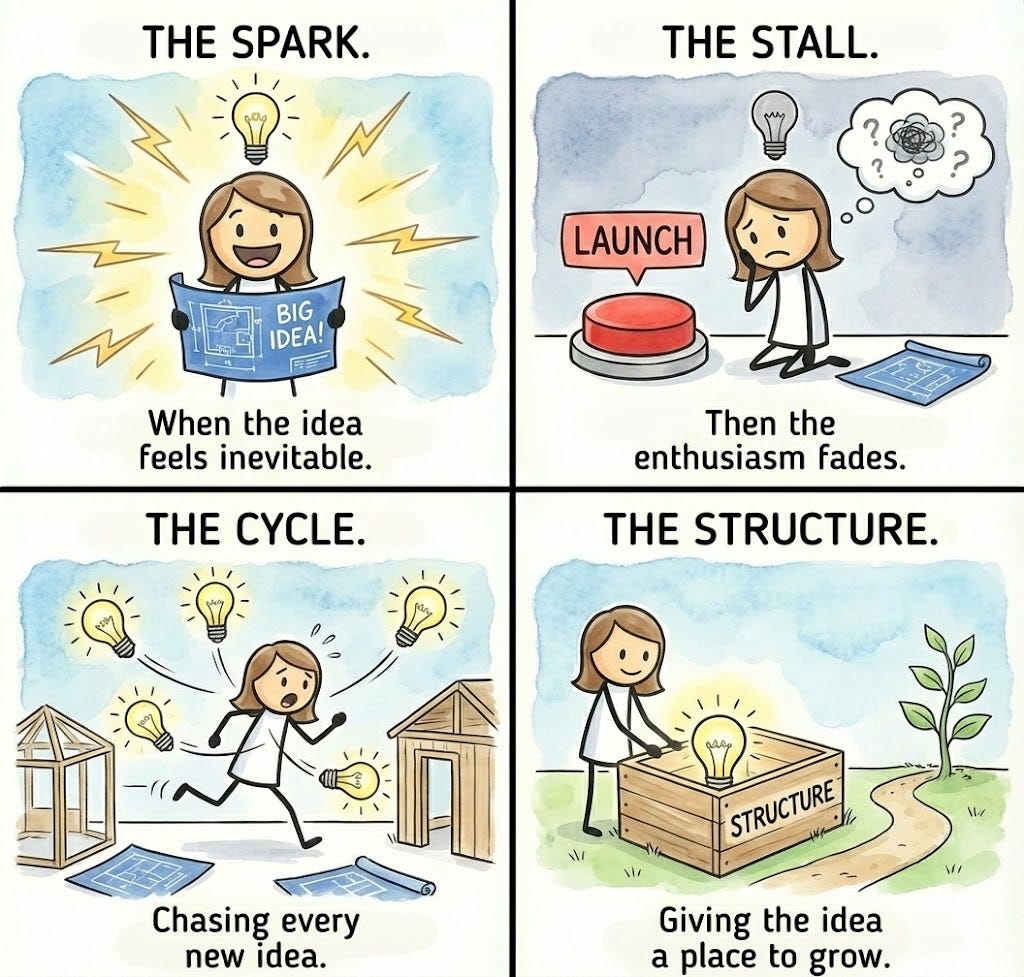
The enthusiasm fades.
A new idea arrives.
You shift your attention.
Repeat.
I spoke with someone recently who described this cycle almost word for word. Anytime an idea landed, she tried to build the entire business in one shot. The rush was real. So was the crash. It wasn’t that she lacked skill or follow-through — she simply had more ideas than she had structure to hold them.
And that’s really the issue:
Ideas are easy to produce.
Businesses are not.
I say that without judgment. The online world almost trains people to believe that inspiration equals progress. For intuitive or creative entrepreneurs, this is especially tricky. The internal world is vivid, fast-moving, and meaningful. When a new idea shows up, it often feels more right than whatever you were building yesterday.
But when every new idea replaces the last, the business never compounds. It just resets.
This isn’t about mindset. It’s not about “blocks.” It’s not even about discipline in the traditional sense. It’s about something much simpler:
A business can’t develop if its owner keeps switching games.
When the woman I spoke to said, “I haven’t shared the offer yet — it’s still landing,” she wasn’t making excuses. She was describing something a lot of people do: they finish the work but don’t finalize the commitment. The product exists. The pages exist. But the decision to stand behind it isn’t solid.
Why?
Because choosing one direction means setting aside a dozen others.
And for people who are used to following inspiration, narrowing anything down feels like losing possibility.
The irony is that constraint is the thing that makes any idea actionable. Without it, the business remains a sketch — detailed, thoughtful, and perpetually unfinished.
Years ago, I had the same tendency. Fifteen different notes named some variation of “This could be something.” None of them became something because I was always waiting for a signal that felt unmistakable. That signal never came. What finally moved things forward was deciding on one path and building a structure around it.
That word — structure — tends to make people tense. It sounds like rigidity, schedules, productivity hacks, and everything that drains the joy out of meaningful work. But structure doesn’t have to look like that. At its most basic, structure is just:
• deciding what you’re building
• deciding how it will work
• deciding how people will find it
And then giving those decisions time to play out.
For the woman on the call, this didn’t require a complex system or a 12-week plan. She works best with spacious days, shorter sessions, and minimal context switching. She doesn’t want a weekly-standing-appointment kind of business. Fine. That’s workable. Her business can be designed around that.
A simple container — something she can repeat — would do far more for her business than another flood of inspiration.
Because what actually creates momentum isn’t the idea. It’s the stability around the idea.
None of this is glamorous. It won’t produce a surge of adrenaline or a hit of transcendence. But it does something more important: it turns creative potential into something another person can recognize, trust, and pay for.
And once a direction is chosen and supported with even modest structure, something interesting happens. Intuition gets clearer, not weaker. Instead of generating endless competing possibilities, it starts generating useful refinements inside a defined path.
That’s when intuition becomes an asset rather than a distraction.
So no — you can’t download your way into a business.
Not because downloads aren’t real or valuable, but because inspiration has a short half-life. It’s only as strong as the structure that carries it forward.
A business needs choices, commitments, and consistency. Nothing extreme — just enough to give your ideas a place to land and develop.
Once that exists, the work becomes far easier. And the ideas don’t disappear; they simply stop competing with one another.
If you’ve been living in cycles of excitement → execution → stall, the issue probably isn’t clarity or confidence. It’s that ideas are arriving faster than the structure needed to hold them.
Build that structure — lightly, intentionally, on your terms — and you finally stop starting over. The business becomes real, not because you forced it, but because you gave it something tangible to grow inside.
But here’s the part I’m still thinking about, and I don’t have a tidy answer for it:
Every entrepreneur I know tries to strike a balance between inspiration and structure — enough to hold their ideas without suffocating them.
Some find it early.
Some never find it.
Most experiment for a long time.
Where is that line for you? How do you tell when structure supports you… and when it starts to get in the way?
Want to go deeper?
Here’s how we can help you get clear, get visible, and get clients:
Take the Harmony Map Assessment (Free): Find out which pattern is blocking your clarity, visibility, or ability to get the right clients. 8 minutes. You’ll see exactly what’s been in the way, and why strategy alone hasn’t fixed it.
Read the Sacred Business Manifesto (Free): The full philosophy behind how we work, why inner patterns create outer business challenges, and what it means to build from both sides.
Spread The Love
I was recently inspired by Sam Illingworth and his Slow AI Supporters Programme, and thought, how could we also bring attentions and support to some of the creators that we’ve been gifted to come into contact with here on Substack? So I’m going to try adding a share of something I feel deserves recognition with each of our essays. I like Sam’s idea of nominations and the concern for bias as well, so maybe I’ll swing back to that when I have a bit more bandwidth to think it through :)
But for today, I bring you Disrupt the Pattern, Episode 009, by Josh Woll. Josh is out here doing beautiful work helping people quit drinking, and I feel his work deserves far more visibility. He’s also a creative genius with his ninja video skills.
Check out this super cool video animation he made for his upcoming 30-day No Alcohol Challenge:

Thanks Phil, this is such a great post. If I'm honest about the point where structure starts to hinder me, it's where I become obsessed with following the framework rather than using it as a way to scaffold my creativity. At that point, I know that I need to either revisit the structure or break free from it entirely.