


We were on a river boat trip this past weekend in a very pretty location near the city, but it felt like we were somewhere in the middle of the jungle. Caimans, capybaras, the smell of the swamp.
It made the scenery very special. And from time to time we could see the high rises far on the horizon.
Eight people on a big enough boat. A group of four at the back near the driver, a couple at the front, and Phil and I somewhere in the middle, a few meters from everyone else.
One man from the group was loud. He wanted a beer. He wanted to smoke his cigarettes. The boat driver said, technically you can’t smoke here, but if they don’t care, I’m fine, pointing at us.
Why am I sharing this?
Because I used to be someone who was “fine” with most things. And that fine, I now know, was not fine at all.
You might see yourself in this.
Often it can’t be perceived as a problem because from the outside you look easy, flexible, cool. Nobody notices you because you are not the one disagreeing. You actually look like the one trying to find a solution, or at least not contributing to arguments or conflicts.
But look closer.
You don’t share your preference in a group so you don’t add complexity to the decision. The AC is cranking and you are freezing but you don’t ask to turn it up. You would rather stay home but you leave anyway to please someone you love. You don’t like a certain attitude but you take a deep breath and say nothing.
So many small moments. So much quiet disappearing.
This is a pattern. One that activates your physiology to operate in survival. It was built to avoid conflict, confusion, discussion. It is not authentic. It is not peaceful, even though it looks like peace from the outside. Very often it creates resentment and frustration. It also widens the gap between the clarity of what is in your heart and your ability to say it. You feel it, but you can’t name it.
When the man turned to me and asked, do you care if I smoke? My first thought was: it’s fine, the boat is big enough, I can just move.
If I was operating on autopilot, that response would have come quickly out of my mouth. Yeah, fine. I’ll move a few meters away or just stay and deal with the smoke.
But I felt my body.
A light twitch in my throat. My body very subtly moving backwards, as if trying to create distance from that situation.
And a thought that followed: is this actually okay?
I paused. Just a split second. And then I responded, very calmly: I do care. I would rather you not smoke here.
His face fell. Oh, you do care. Okay. He was not expecting that response. I could sense frustration coming from him.
He did not smoke. I did not move. We enjoyed the rest of the trip without cigarette smoke.
When you operate in the pattern, you would rather deal with your own discomfort smelling the smoke than feel someone else’s frustration with something you did.
It gets very interesting…
We think reacting means losing control. Exploding. Expressing something too big, too loud, too much.
Yes, that can be a reaction.
But so is the one where you go quiet. Where you silence your needs. Where you look polite and easy from the outside, the nice person who helps everyone get what they want. The saying yes with a smile, or just saying oh don’t worry, it’s okay.
That too can be a reaction.
Here is what reaction means in this context.
And it is important to say that a reaction is not always an action. It can be an emotion. The frustration you feel but don’t name. The discomfort you register but immediately dismiss. The tightness in your chest that you decide means nothing and move on. Those are reactions too, happening before any word ever leaves your mouth.
Whether it stays inside or comes out, a reaction is any response, felt or expressed, without awareness of the present moment.
It is not based on what is actually happening now. It is based on what happened before. It follows an old path already created in your brain, a familiar route the nervous system defaults to because it is fast, efficient, and once kept you safe. It happens below conscious thought. By the time you realize what you felt or did, you already felt it or did it.
It is a stress response. It is the automatic response of appeasing, pleasing, making yourself small so there is no conflict. It looks like flexibility. It looks like kindness. From the outside it looks like you are easy to be with.
But it is not kindness. It is the nervous system choosing what feels safe over what is true.
That is the “fine.”
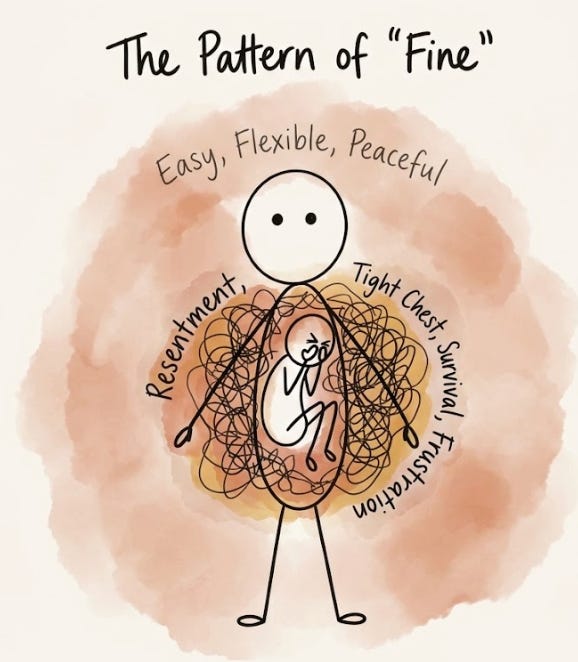
That is the nice person who helps everyone get what they want, except themselves. That is a pattern wired into the body, running on an old instruction that no longer applies.
So that smile, that okayness, that too is reaction.
And in the name of everybody else’s peace, you never get what you want. Not the restaurant, not the temperature, not the music. And not the life.
If I had said yes to that man, the moment I smelled that smoke I would have felt bothered. And I would have turned it on him immediately. Why is he doing this in the middle of nature? I would feel disturbed, frustrated, upset.
I was watching the sun setting over the water. That peace would have been swallowed by the smell of his cigarettes.
But he would not have been the problem. His cigarettes were not the problem.
I would be reacting to the consequence of my own unspoken no.
That is what unconscious patterns do. They make you the victim of a situation you actually created.
If I had said yes and truly meant it, the smoke would not bother me. Because there is no betrayal. A real yes has no residue. You chose it, you own it, the smoke is just smoke. Even not enjoying the smell, I would be okay within myself, because I had given a full yes.
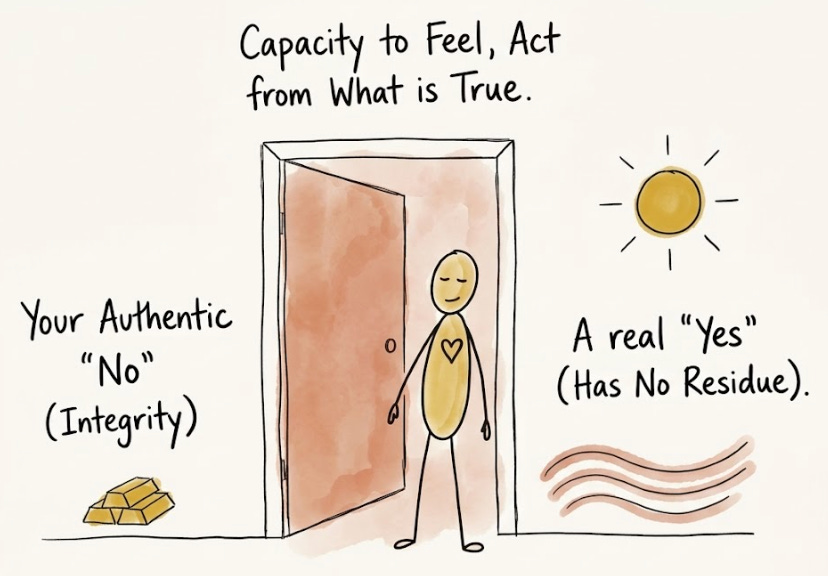
The resentment does not come from the smoke. It comes from the moment you said something your body did not agree with. Everything after, the irritation, the blame, the quiet anger, is just the wound talking.
So the question is never just did you say yes or no.
The question is: did you check in with yourself before you answered?
This is where the body becomes your greatest teacher.
He asks the question. My body receives it. Before I even think, it travels to what is familiar. The path that says yes, move, be easy, don’t make it complicated.
But then something else happens. A contraction. A signal. The body saying: wait, this doesn’t feel right.
Your brain has a preferred path. The one it has walked a thousand times before. It is efficient. It is fast. And it will keep choosing the familiar response until something interrupts it.
That interruption is the contraction. The twitch. The small moment of friction between what is familiar and what is true in that moment.
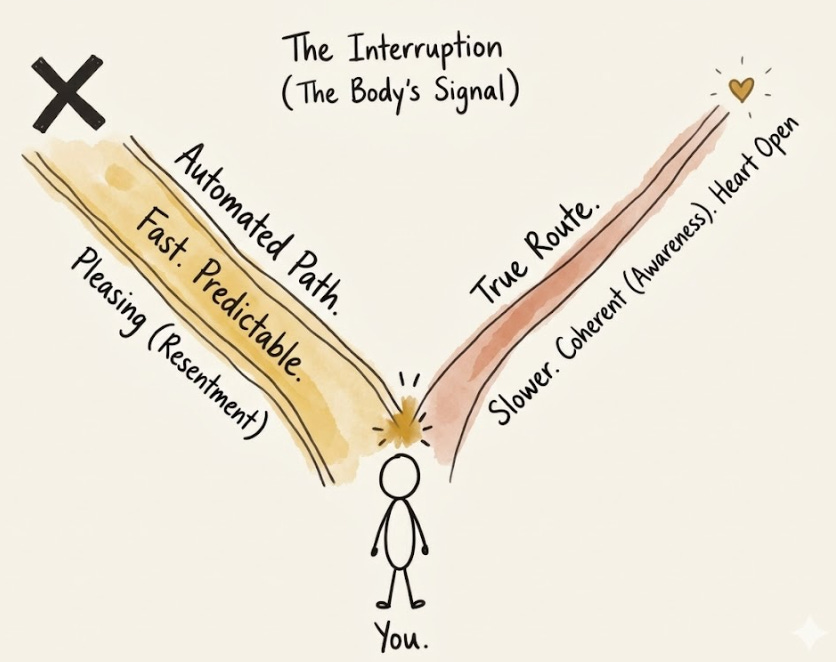
That signal is not weakness. That is your wisdom. In that moment you can choose.
And when you do something different based on what is important to you in the present moment, you break a pattern.
A new pathway starts being created.
Now it is your practice to keep reinforcing it.
Most people miss it. Because they have been living from the neck up for so long that the body’s messages feel like background noise.
This is what I mean when I talk about building capacity. Not capacity to endure more. Capacity to feel more, and to act from what is now true. Saying no to that man still didn’t feel like the easy path. My body felt the discomfort of it.
But I am aware enough now to know that the uncomfortable thing and the wrong thing are not always the same.
The pattern doesn’t break in the mind. It breaks in the different action you take with the awareness that you now have.
And that action doesn’t always look the same. It is not about saying yes or no. It is about taking the action that is coherent with what is true for you in that moment. The one that lets you keep your heart open. The one that lets you keep choosing yourself, even when that choice brings frustration or disappointment to someone else.
That is the door to build an authentic life and business.
With Love,
Carolina
If this essay touched something in you, I want to invite you to go one layer deeper.
The pattern you just read about has a frequency signature. And the Harmony Map is a free assessment that will show you exactly which of your nine frequencies is calling for a new relationship in your Business. Not so you can analyze yourself. So you can finally see clearly where to begin.
Such an interesting human phenomenon. I'm glad you said no. I've notice what you metioned about our physiology is very true. In essence, it takes time, thought, effort to protect our own selves from our survival mechanisms. Don't put the necessary boundaries in place and we get overstimulated even further.
An adjacent thought: It took extra time and energy for you to say no. Some people are so exhausted and overstimulated - that it takes extra down time to re-regulate their physiology - before being able to say no - and then afterwards do they enjoy the boat trip further? Thankfully, it sounds like you were able to. But some others would either skip the effort out of "kindness" - others out of exhaustion - others don't even understand what is going on below the surface of what you lay out here.
It's like reaching a deadline that is important - and you don't even celebrate the win. Why? - Now that is worth unpacking!
Solid write up! Thank you for taking the time and effort to show up!
“And in the name of everybody else’s peace, you never get what you want.” So good and so true. You end up with a life that doesn’t feel like your own because you are not honoring your own needs. This was a great read! Thank you!