



I was on a call with a client last week. She’s talented, committed, and has a newsletter that genuinely helps people. But when I asked how her engagement was going, she sighed.
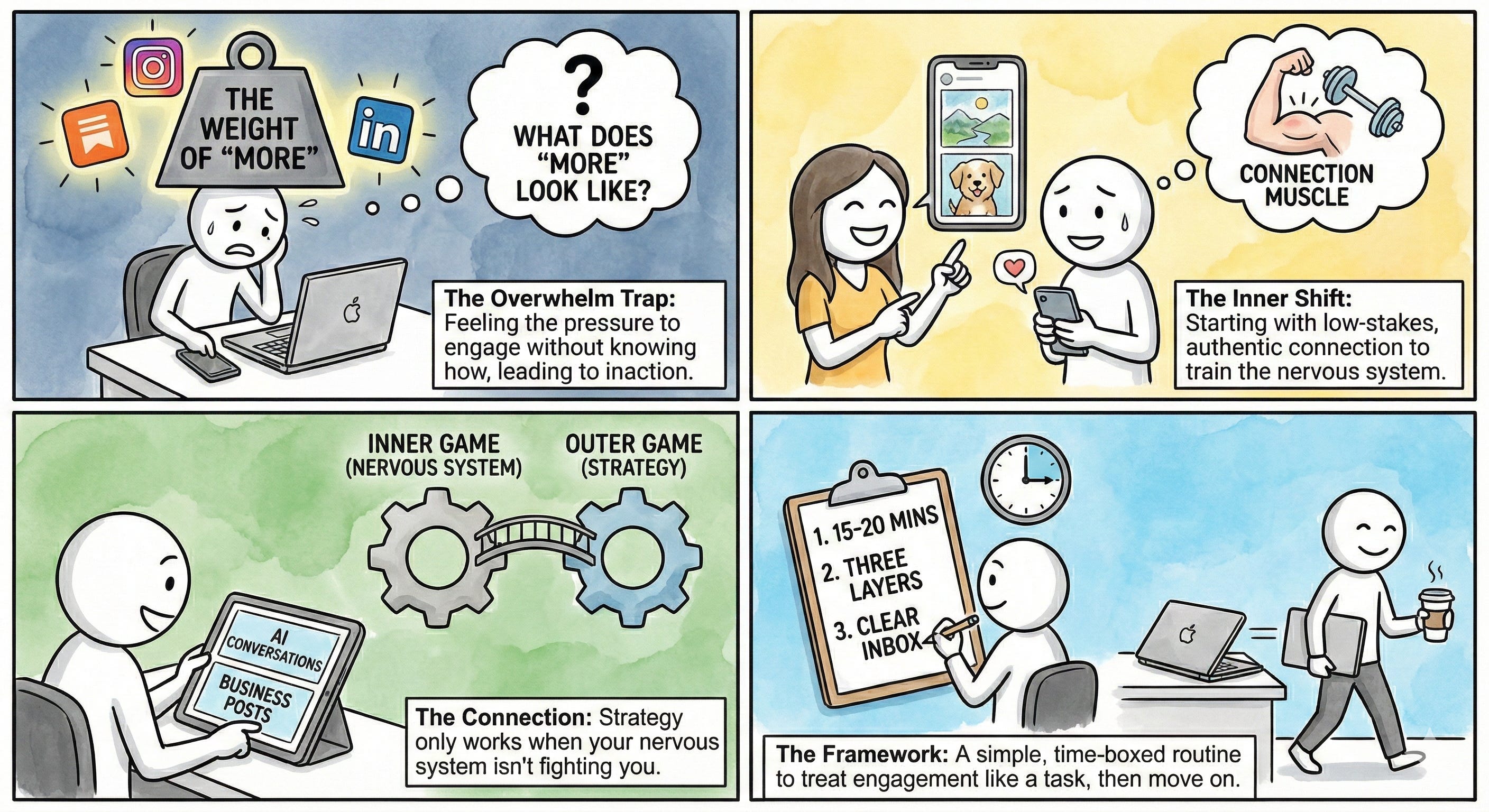
“I know I need to be on Substack more. But every time I open the app, I feel this weight. Like I should be doing more. Engaging more. But I don’t know what ‘more’ even looks like. So I just... don’t.”
Her Instagram looks the same. Her LinkedIn sits dormant. And the newsletter she pours her heart into keeps getting published to crickets.
I’ve heard versions of this from so many creators I’ve worked with.
Here’s the thing: the problem isn’t that you’re lazy. The problem is that nobody taught you the actual game being played. You’re measuring yourself against people who spend 10 hours a day on social media. Or against creators whose “overnight success” took seven years of invisible work.
Mia Kiraki 🎭 named this trap perfectly in a comment last week:
"Comparing early days to someone else's peak is a sure way to feel like you're losing when you're actually winning. I've seen plenty of early creators feeling like failures but actually beating benchmarks. Just because they fall into the trap of comparing their first steps with someone else's year 7."
What if there was a simpler way?
Why Connection Feels Heavy
When I explained my engagement process to Carolina, she had a different take than I expected.
“Most people make connection heavy because they need something from it,” she said. “They need the likes. They need the response. They need validation that they’re doing it right. And that need is exhausting. The minute you’re connecting because you want to get something, you’re not even sharing authentically. You’re trying to figure out how others will understand what you want to share. That’s where the heaviness comes from.”
She’s right. I’ve watched people approach engagement like a chore they resent. Of course it doesn’t work. The energy comes through.
Carolina Wilke’s approach was different.
“I started by following things I actually loved. Watercolor accounts. People posting about travel. Cute dogs. And I would comment on those. Not strategically. Just because I genuinely wanted to express my gratitude for something they shared. I was training my nervous system to be social online. Building the muscle.”
She wasn’t thinking about algorithms. She was practicing connection in low-stakes spaces until it stopped feeling like work.
“Then,” she said,
“once that felt natural, I added the strategic layer. Now I comment on AI conversations and business posts because I actually want to, not because I have to. If I only followed cute dogs, I wouldn’t make money. If I only did strategy, it would feel terrible. You need both.”
This is what I mean when I say everything is connected. The inner game and the outer game aren’t separate. The strategy only works when your nervous system isn’t fighting you.
The Real Game
I’ve spent months studying what’s actually working on Substack. Not the theories. The math. I’ve looked at other creators who were growing quickly and sustainably. Who weren’t burned out. Who actually seemed to enjoy showing up.
I’ve learned a ton from watching people like Mack Collier break down the algorithm, from Landon Poburan’s experiments with notes, from how Write • Build • Scale systematizes their engagement. The Substack creator community is generous with what’s working.
Their stuff really works. In fact, much of what I am sharing here shares influence by their ideas and there is overlap we all have in our ways of approaching engagement.
But as I tested these ideas with clients who have challenges with resistance specifically, I kept running into the same wall. The tactics made sense. The execution fell apart. Not because people didn’t understand what to do. Because something underneath was stopping them.
So Carolina and I developed a framework that addresses both: the strategy and the resistance.
Here’s the short version: 15 to 20 minutes a day. Three layers of engagement. Treat it like clearing your inbox. Then close Substack and get back to your actual life.
That’s it.
Let me show you exactly how it works.
In addition to this detailed playbook, Sacred Business Network members get the tracking spreadsheet, weekly review template, daily rhythm checklist, and 7-page guide about what actually makes this system work. We’ll be rolling these out to paid subscribers this week. Plus ongoing insider looks at what’s actually performing for us.
Want to practice in a safe space with people who’ll engage while you build the muscle?
Join for $15/month