


You might feel a strange mix of things reading this.
Some relief. Some resistance. Perhaps a low hum of “I already know this” fighting with “but why can’t I do anything about it?”
All of it makes sense.
This essay is about something most people sense but rarely name: the gap between who you are as a person and how you show up in your work. That quiet disconnect. The way your work can feel like it's happening to someone else, or for someone else, even when you're the one who shows up every day.
This separation protected something worth protecting. Your sensitivity, your depth, the parts of you that don’t survive well in transactional environments. At some point, you learned to keep those parts out of the room where work happens.
That made sense then. It might be costing you now.
If that gap doesn’t exist for you, this probably isn’t your reading for the week. Close this tab. Come back another time. Or skip on to the other parts of the newsletter.
But if you’ve ever felt successful on paper while something inside felt hollow, or found yourself dreading the very work you once couldn’t wait to do, stay here for a bit.
This isn’t about fixing anything. It’s about noticing something that’s been running in the background for a while now.
A pattern shows up in nearly every client Carolina and I work with.
Someone builds a business. Or climbs the corporate ladder. Or lands the role they spent a decade positioning for. It works, at least by external measures. Clients come, or promotions come, or the comp package finally hits the number they’d been chasing. From the outside, things look like they’re moving.
But inside, a different story is playing out.
The work feels like a performance. Showing up feels like acting. Asking for what you need feels like asking for something you don't deserve.
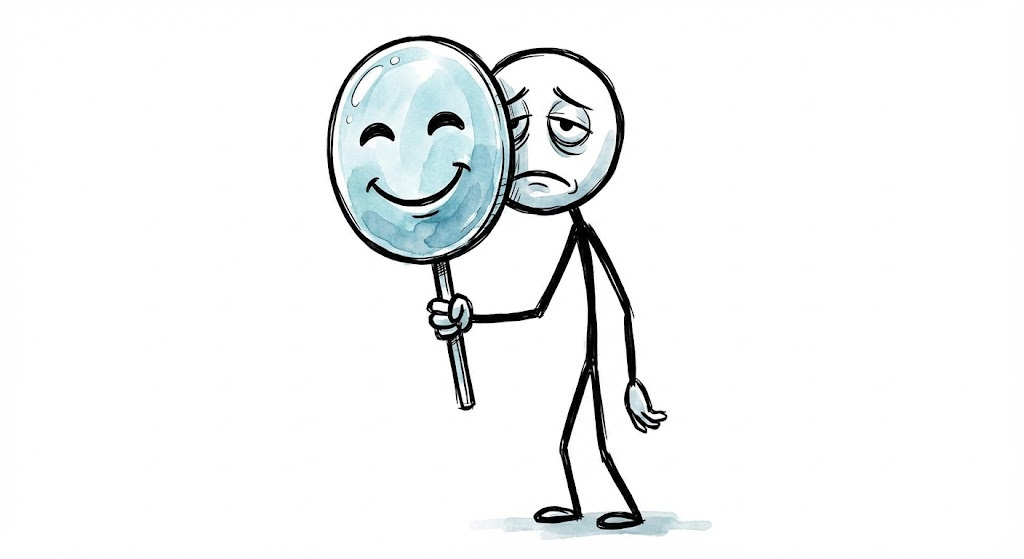
The pattern isn’t laziness. It isn’t lack of strategy.
It’s separation.
Your professional self lives in one room of your life. Your actual self lives in another. And you commute between them, putting on a different face each time you cross the threshold.
This separation makes sense. At some point, you learned that business required a certain version of you. The professional one. The polished one. The one who has answers and doesn’t flinch.
So you built a wall. Not because you’re broken, but because it felt necessary. The wall protected the softer parts of you from the demands of performing. Selling, managing, presenting, leading. Whatever the role required.
The problem is, walls don’t just keep things out. They keep things in. Including your energy, your clarity, and your ability to show up without that quiet pull on your reserves.
I see this pattern in executives who've spent twenty years climbing. I see it in founders who built something from nothing. The context is different. The separation is the same.
Back in 2019, I was running a consulting business in the hearing industry.
By every measure that mattered to the world, it was working. Six-figure months. A client roster that kept growing. The kind of revenue trajectory people put on slides at conferences.
And I remember standing in my kitchen one morning, coffee in hand, staring out the window at nothing in particular, feeling absolutely nothing about any of it.
Not grateful, not excited, not even stressed in a way that felt useful. Flat.
My body had started sending memos I kept ignoring. Headaches that wouldn’t quit. A jaw so tight my dentist asked if I was grinding my teeth at night. Background anxiety that showed up around 4pm every day like clockwork.
I noticed I’d been holding my breath through entire Zoom calls, exhaling only after I hit “Leave Meeting.”
I kept telling myself the problem was tactical. I needed better systems. To grow the team to take some of the workload off of me. Maybe a different niche.
But the real problem was simpler and harder to solve.
I had built a business that worked. It didn’t feel like mine.
The person who showed up on client calls wasn’t exactly me. He was a competent, confident version of me who said the right things and closed the deals and then collapsed on the couch at 8pm, unable to explain why success felt so heavy.
I didn’t have language for it then. I knew something was off. I kept looking at the numbers, waiting for them to tell me why I wasn’t happy.
They never did.
You already know what it feels like to be whole while you work. You’ve felt it. Maybe not recently, but it’s in there somewhere.
That feeling isn’t something you build from scratch. You remember it. It was there before you learned to compartmentalize. Before someone told you that business is business and feelings are feelings and never the two shall meet.
Think about the last time work didn’t feel like work. Not because it was easy, but because it was yours. When the doing and the being were the same thing.
The last time you helped someone without thinking about what you’d get back. The conversation that went long because you forgot to watch the clock.
That was connection. It didn’t require effort.
The feeling isn’t reserved for artists or monks or people with trust funds. It’s available to anyone willing to stop treating their work like a role they have to perform, and start treating it like an extension of how they move through the world.
This doesn’t mean your work becomes your therapy. It doesn’t mean every client call needs to feel like a spiritual experience.
It means the wall comes down. Or at least, gets a few doors cut into it.
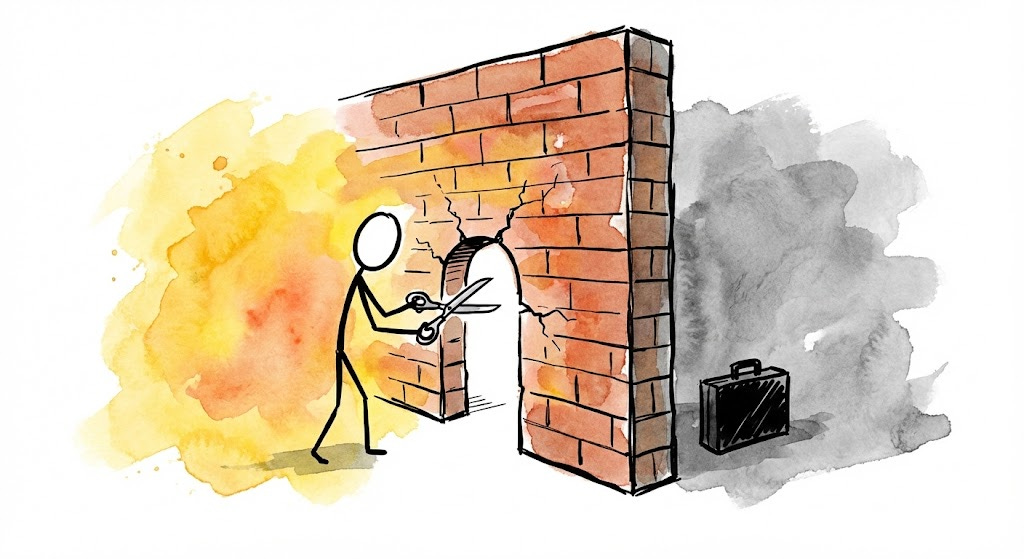
You don’t have to become a different person. You stop pretending to be one.
The Practice
This week, try a simple check-in before you start any work task.
Pause for ten seconds. Put your hand on your chest or your stomach, wherever feels natural. Ask one question: “Am I here?”

You’re not trying to get centered. You’re not trying to breathe your way to enlightenment. You’re noticing whether you’ve shown up, or whether some professional avatar has shown up instead.
Do this before you open your email. Before you get on a call. Before you write that post or send that invoice.
Don’t expect anything to shift immediately. This isn’t a hack. It’s a practice of noticing the gap when it’s there.
Over time, noticing changes things. But not on your timeline.
Some days you’ll check in and realize you’ve been absent for hours. Just notice that.
If You Want to Go Deeper
Choose one of these.
Write for five minutes on this prompt: “The version of me that shows up in my business is different from the real me because...” Don’t edit. Don’t make it make sense. Let it come out.
Or try this: Pick one recurring task this week, something you do regularly that usually feels like a slog. Before you do it, ask yourself what would change if you did this task as yourself, not as your business persona.
Notice what happens. Something might shift.
Where This Shows Up in Your Work
These are signals. They tell you where the separation is showing up.
Visibility becomes exhausting. Not because you're introverted, but because every time you show up, you're performing. In the meeting, on the call, in the presentation. You're putting on the professional version of you, and performances drain energy. The real you stays hidden, which means nobody sees the real you, which means the people who would genuinely resonate with you can't find you.
Compensation feels like a negotiation with your own worthiness. Whether you're setting prices or negotiating salary, when your professional self is separate from your real self, asking for money triggers the question of which self deserves it. The professional one can make a case. The real one isn't so sure.
Consistency becomes a willpower problem. You start things with energy because the business self gets excited about new projects. Then the real self has to show up and do the work. The two don’t always agree on what matters.
Decision-making gets slow and second-guessed. Without a clear sense of who’s running this thing, every choice becomes a debate between personas. Should I do what’s strategic? What feels true? What looks professional? The questions multiply because there’s no unified self to answer them.
This Week’s Questions
At the end of this week, sit with these. No need to write answers. Notice what comes up.
When did I feel most like myself in my work this week?
When did I feel like I was performing?
What task did I dread, and what version of me was dreading it?
Did I notice the gap between who I am and how I showed up? Even once?
What would have been different if I’d shown up as myself?
What surprised me?
The gap between who you are and how you work didn’t form overnight. It won’t close overnight either. And closing it completely isn’t even the goal.
Noticing it is.
You’re not behind. You’re right where you’d expect to be, given what you’ve been carrying.
I’ll be honest: I still catch myself in this as well.
Last Tuesday, I noticed I’d been holding my breath on a call. Not a hard call. A call with someone I like. But somewhere between “hello” and “let’s talk next week,” the professional version showed up and the real one stepped aside.
Seven years later, and the pattern is still there on some level.
I’m starting to think the goal isn’t to stop it. Maybe the goal is to notice faster. To shorten the lag between separation and return.
I’m still in that work. It is an ongoing practice.
If you’re in it too, tell me what you’re noticing.
Phil
P.S. If you want to see what other patterns might be running, the Sacred Business Harmony Map can help. It’s a free assessment that measures nine frequencies, including Connection. Takes about ten minutes. No email required to see your results. Take the Harmony Map →
Happenings
This Week on Sacred Business Stories w/ Kevin Rogers
Kevin Rogers built CopyChief into an 11-year powerhouse. Live events with 300 people flying in from around the world. A coaching program that actually worked. By every external measure, he’d made it.
Then he walked away from all of it.
Kevin talked about the moment his business stopped feeling like his. About needing five approvals to send his own emails. About being “banned from pushing buttons” in his own software. The guy who built his success on spontaneous connection couldn’t wake up with an idea and share it anymore.
Sound familiar?
If this week’s essay resonated, Kevin’s story is the same pattern playing out at scale. He achieved everything he set out to achieve, and somewhere along the way, the professional version took over completely. Now he’s 55, starting fresh, sitting with uncertainty, and being incredibly honest about it.
His line that stopped me:
“There’s no workbook for what comes next. You just have to let go of any expectation for what life might have waiting for you.”
Listen to the full conversation →
Interview w/ Fabio Posca on the Notes Playbook
If you are curious about how we approach Substack notes, this is worth a listen.

The gap between who you are and how you show up at work doesn’t close on its own. Most people try to think their way out. Read another book. Take another course. Hope that this time the insight sticks.
It rarely does.
The pattern runs deeper than information can reach.
Carolina and I created something called the Serve & Receive Partnership for exactly this.
Over 90 days, we build three things together: the frequency alignment that stops you from sabotaging yourself, clarity on what you’re actually here to do, and a structure that makes follow-through possible.
Whether you’re building something of your own or figuring out what comes next, the work is the same. Get clear on who you are. Then build from there.
You also get a full year of support to make sure it sticks. But the foundation happens in the first 90 days.
Learn more about Serve & Receive →
Who We Are Celebrating This Week: Jeff Kimes
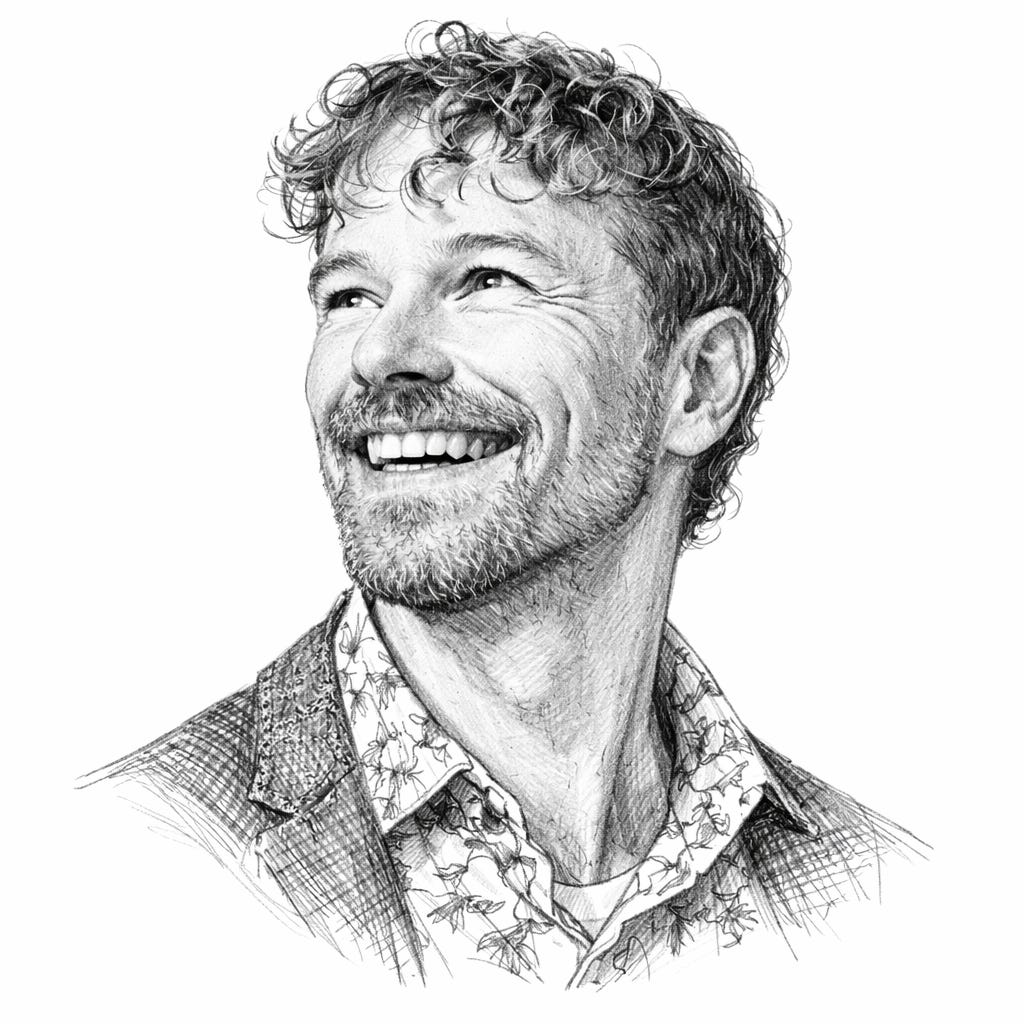
Jeff Kimes started publishing on Substack recently. And he came out swinging.
His first series, “Creative Agency in an Age of Collapse,” names something most of us feel but can’t quite articulate: the most brilliant, creative minds of our generation are trapped in systems that waste their gifts.
The visionary artist working as a UX designer for Microsoft. The brilliant music producer grinding 60-hour weeks in the bowels of Amazon. The writer locked into copywriting, his own stories shelved to sell other people’s widgets.
Jeff calls it “creative constipation.” We have everything we need to transform our world. The talent exists. The vision exists. The capacity exists. It’s just stuck.
If this week’s essay about the gap between who you are and how you show up hit close to home, Jeff’s writing is the macro view of the same pattern. Individual disconnection scaled up to civilizational crisis.
But here’s what I love about Jeff’s work: he doesn’t stop at the diagnosis. He gets into systems dynamics, strange attractors, and why collapse actually creates the conditions for transformation. His take: this is the age of the artist. Not because we have all the answers, but because we’re the ones who can seed new ideas in the fertile compost of what’s falling apart.
His words:
“In those quiet moments, between projects, late at nights staring at the stars, there’s a low-grade despair I can’t quite shake. This sense that I’m not doing what I’m actually here to do. That I let a side-quest become the whole game.”
Jeff describes himself as a multi-passionate creative and neuroscience nerd exploring the intersection of creativity, natural systems, and songlines of culture. Marketing strategist by day. Musician and girl dad by night.
He’s in motion. And his writing is worth your attention.
Read “Creative Agency in an Age of Collapse” →
Things I’d Like to Share
The forbidden question in client retention
Filip Sardi 🌊 wrote something that made me uncomfortable in the best way. He noticed that when he asks founders about client churn, they react like he just said Voldemort’s name.
We tell ourselves we don’t have time to look at the data, or that we need more clients before we can worry about keeping them, or that churn is outside our control anyway. But underneath all of it: the sting of not being enough. The fear that if we look too closely, we’ll confirm something we don’t want to know.

Filip’s take: the founders who are willing to look without flinching are the ones who actually improve. Not because the data is comfortable. Because they stop letting shame run the show.
(Full disclosure: Carolina and I are featured in this piece. Filip looked under the hood of our business and showed us something we couldn’t see ourselves. Worth the discomfort.)
Read “The shame behind the forbidden question in client retention” →
Design Your Creative House: a weekend sprint
Rachel Connor is running a free 3-day challenge at the end of February, and the premise stopped me mid-scroll.
When she was a child, she used to draw floor plans of imaginary houses. Not the outside. The inside: secret rooms, back staircases, the attic where she’d hide and write. Years later she realized she wasn’t drawing a house she wanted to live in. She was mapping one she already lived in.
The challenge invites you to do the same for your creative life. Draw the floor plan. Name the rooms. Find the heart. Stand at the threshold of the room you’ve been avoiding.
Her point: before you can change your creative life, you need to see it. Not the life you wish you had. The one you’re actually living.
The challenge runs February 27 to March 1. Free. Twenty minutes a day. Wobbly lines welcome.
We sat down to talk with Rachel about it here this past week
Also worth Checking out:
Josh Woll on building a collective
Eva Chen on turning the page on an old story.
Marc Engel on growing your organism.
Notes I Loved This Week
Memorable Quote
“Afraid that our inner light will be extinguished or our inner darkness exposed, we hide our true identities from each other. In the process, we become separated from our own souls. We end up living divided lives.”
from A Hidden Wholeness: The Journey Toward an Undivided Life
If you read this and felt something stir, but you’re not sure what to do with it, that’s okay.
You don’t need to know exactly what you want. You don’t need to impress us. You don’t need a polished pitch for your business or a clear explanation of why you’re stuck.
You just need to be honest about where you are.
Maybe you’ve been scattered across too many ideas and you’re looking for the one that would organize everything else. Maybe you’ve been sitting in rooms that only speak half your language, strategy without soul or spirit without systems, and you’re tired of choosing. Maybe you just want to be in a conversation where both parts of you are welcome.
This is 30 minutes for us to listen, ask a few questions, and share what we see. We’ll talk about what you’re building, what’s getting in the way, and whether working together makes sense.
P.S. You can read all previous editions of the newsletter here, and you can upgrade your subscription here.
"If that gap doesn’t exist for you..." This is where I landed when I started reading (had to get to the end though haha) I have spent years working towards the space I am in today, where my businesses are an extention of who I am, not a separate entity. So much so that I always feel the dissonance deep inside me whenever I am making business choices that do not align with who I am. The lethargy and dread I feel is always unmatched and I work very hard to get back to an aligned version of my business. Which also means that I truly understand why it is so important to show up as your true self inside your work.
"Am I here?" is a brilliantly powerful and simple way to notice and come back to the moment. I wrote recently about unlearning assimilation at work and I appreciate your framing around performance <3