


There’s something I see often in people who’ve done a lot of inner work.
They’re not beginners. They know the practices. They have a relationship with their body, their breath, their nervous system. They can recognize a stress response in real time. They know how to resource themselves.
And they’re still not doing the thing they came here to do.
This used to confuse me. I assumed the problem was information, or strategy, or the right support. But when I looked more carefully, something else was happening.
The practices were working. That was the problem.
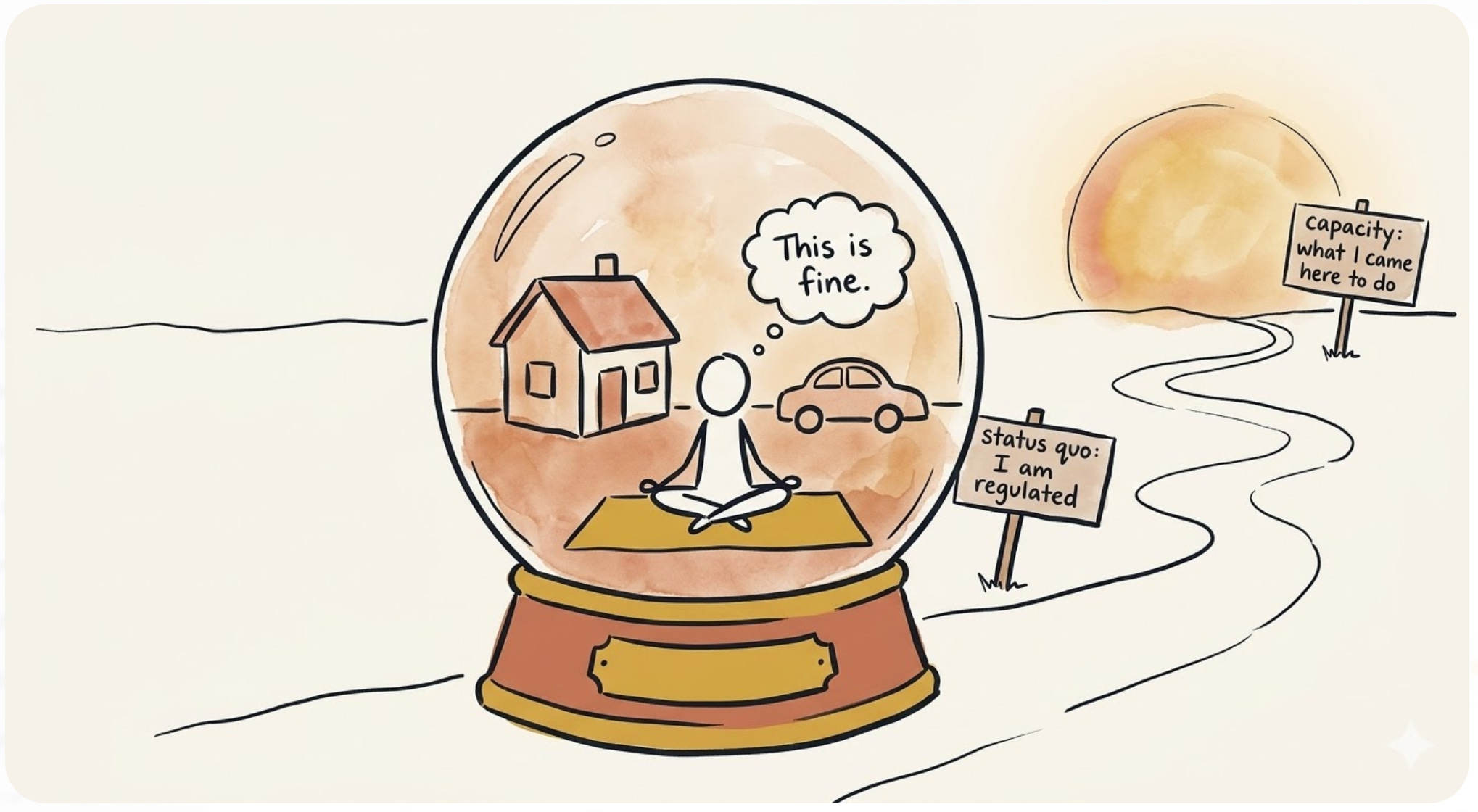
Here’s what I mean. When you learn to regulate your nervous system, you learn to move from dysregulation to stability. You learn to bring yourself back. To find ground when things feel shaky. This is genuinely valuable. It took me years to develop that capacity.
But regulation, on its own, is neutral. It returns you to baseline. It doesn’t tell you which baseline to return to.
So if the life you’ve built no longer fits, regulation keeps you comfortable in it. If the work you’re doing has stopped being the right work, a good practice session makes it easier to sit back down and do it again. If there’s something asking for your attention that feels uncomfortable and unfamiliar, your nervous system will treat that discomfort as a signal to regulate, not to investigate.
The practice becomes a lid.
I saw this in myself in São Paulo, during an energy training. I was running through practices I knew well, and I was trying to dissolve a dissatisfaction that had been living in my chest for quite some time. I didn’t like where I was living. The winters. The darkness. My lifestyle wasn’t fitting me anymore.
Every practice I had, I was using the work to convince myself I should be grateful. To get back to “this is fine.”
My teacher said something simple:
“Some people do this work to keep the status quo when the status quo no longer fits.”
I felt that land.
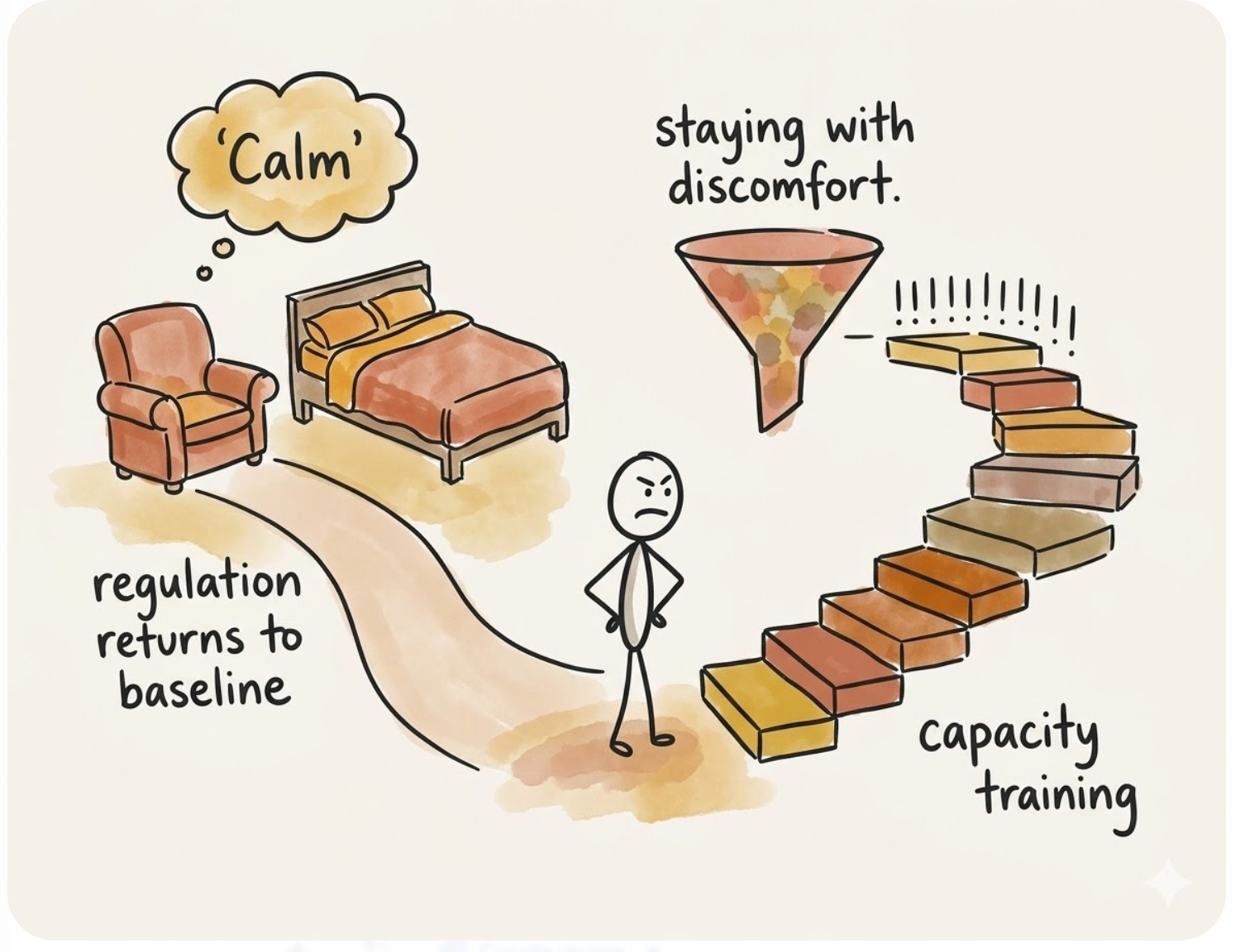
The dissatisfaction wasn’t the problem. It was information. And I had developed a very refined system for ignoring it.
What I had was regulation. What I needed was capacity, which is different.
Regulation returns you to a known state. Capacity lets your system learn that an unknown state isn’t a threat.
So that second thing requires something harder. It requires staying. Staying when you want to close the laptop. When the idea feels inconvenient. When the conversation is uncomfortable. When visibility feels like too much. Staying long enough for your nervous system to update its read on the situation.
That’s not something you do once in a breakthrough session. It’s something you train, right? The way you train anything else. Repetition. Small doses of the unfamiliar, returned to again and again, until familiar is no longer the only option for safe.
For people who’ve done years of inner work, this distinction can be hard to see. The very fluency that makes you effective in one kind of practice can make it easier to miss the other kind. You’ve learned to feel better. That skill is real. But is it the same as learning to move forward when you don’t feel better yet?
When I adjusted my own practice toward capacity rather than calm, the changes weren’t dramatic. Similar movements. Still the breath. Different intention. Instead of trying to feel better, I practiced staying with whatever was there.
Over time, the moments that used to stop me started feeling manageable. Not comfortable. Manageable. And that was enough.
When it was time to write, I wrote. When it was time to make the call, I made it. When it was time to leave my life in Montreal for Costa Rica, I left.
Not because I felt perfectly calm. Because I had trained the capacity to feel a full range of experience and still move toward what I already knew.
I’ve been doing this work with clients for more than five years. Teaching it, refining it, watching what happens when someone’s system learns that expansion isn’t a threat.
I’m ready to open it more widely.
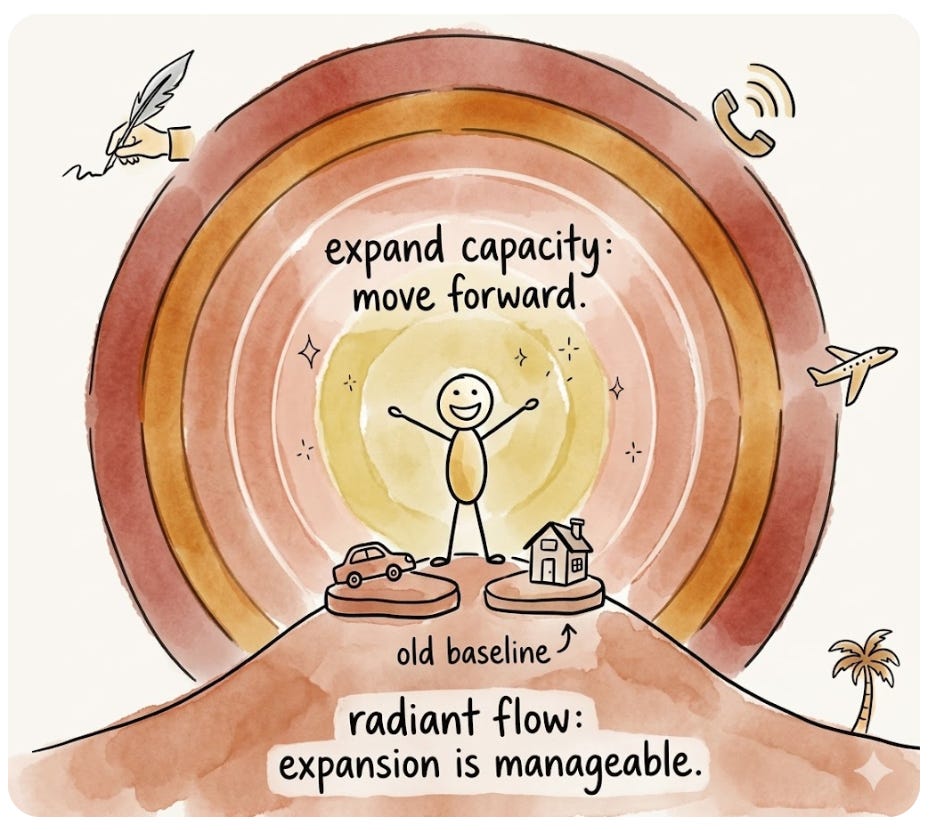
It’s called Radiant Flow. It’s a twice-weekly embodiment practice, designed to build that capacity over time, through consistent repetition rather than occasional breakthroughs.
Founding enrollment opens next week. If you want first access and a founding rate:
Yes, I want to know the moment this opens
Carolina
It is interesting how skills meant to support growth can also become a way of staying where things feel familiar. Many people get very good at soothing discomfort without asking what the discomfort is pointing toward. Learning to stay with uncertainty while still moving forward is a different kind of practice altogether.