


A client told me last week that he figured he should have three hundred subscribers by now, for all the effort he’s put into his notes and essays. He’s got about a hundred or so.
So I asked him a different question.
Do you actually know who your hundred people are?
Because the fact of the matter is that when you’re just getting started building an audience, you can truly take the time to get to know them. Who they are, why they have chosen to give you their attention, what projects they’re working on.
Then I asked him a question that I believe is actually even more important.
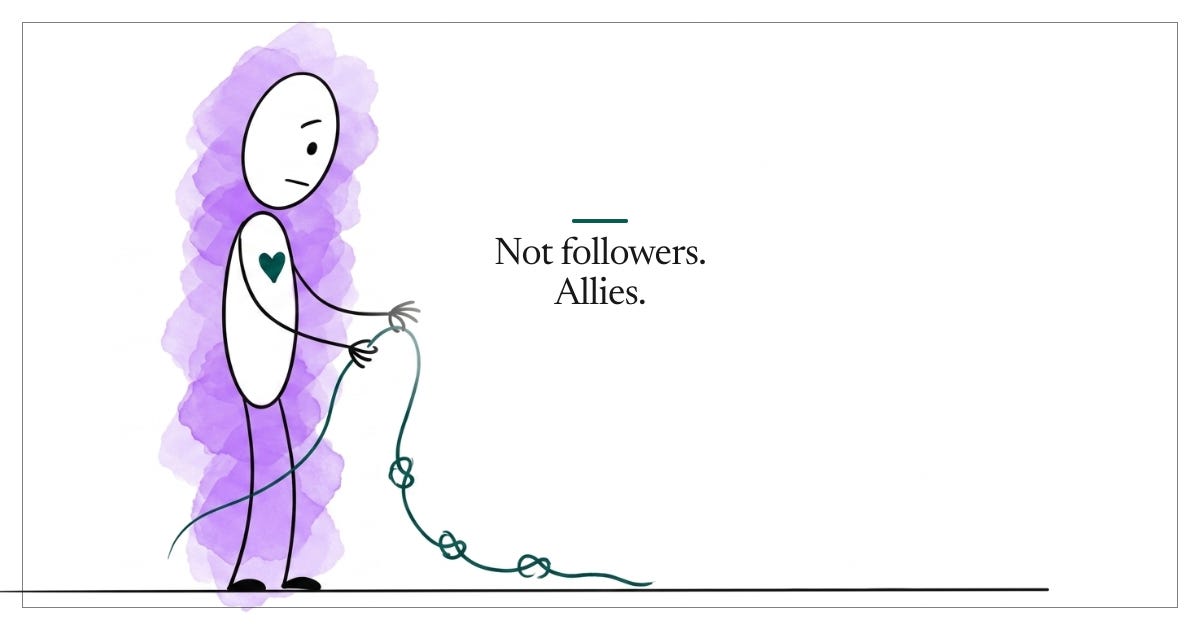
Forget your subscriber count for a second. How many allies have you created?
Not followers. Allies. People who would recommend you, refer you, people you’ve had a conversation with and shared some mutual excitement with.
Colleagues.
I told him that I believe that this is the biggest opportunity on Substack right now, and most people don’t even see it right in front of them.
There’s a huge relational field available right now, and my working hypothesis is that for most people, their relational field is directly correlated with the results they are getting (or not getting) in their business.
the invisible web
Recommendations are nice. But a recommendation is still kind of passive. I can sit here and click a button for you. I never have to have a conversation with you, and you feel good, and maybe you click the button back. That’s fine. It’s just not very relational. It sounds relational, and its a better automated mechanism that most platforms afford you. But still not truly relational. And if you’re only showing up to broadcast, throwing your work into the void and never building real meaningful relationships, that’s usually where things start to break down.
What I’d suggest you focus on is a little bit different, and doesn’t even really feel like a “business metric”.
How many new friends can I make this month?
How many more people can I actually connect with?
Find one interesting conversation a week and have it, then check back in with me in ninety days and let me know how your business growth is going.
It doesn’t get much simpler than that once we allow ourselves to get out of our own way. Andrew Auld♾️ said it well this week in response to one of my notes:
one connection a day becomes compounding evidence.
Related to “business” in this way has worked quite well for us, but it’s pretty hard to explain until you experience the shift for yourself. Carolina Wilke and I have created a web of relationships operating around us that’s mostly invisible, happening below the surface. Authors who recommend us. People who get on a call and tell us something like “someone mentioned you, or, I saw you on that Substack live”. I get a message from someone telling me they thought of us, and they would like to connect us to somebody else. It’s relationship driven. It’s community driven. And it completely shifts the experience of the work.
A couple weeks back I made posted a note about doing laundry here in Brazil, of all things. It took on a life of it’s own. People like Mia Kiraki 🎭 and AI Meets Girlboss playing along, jokingly leaving comments like “I’m coming over”, “I’ll host next time”,
I’ve got a boat somewhere in Europe”. And a handful of the folks on that thread I feel a real sense of friendship with. Not close friends in the traditional sense, but, I like what they are up to, they seem to dig what we do, and if there’s an opportunity to share them with a client that is a good fit for them, I wouldn’t hesitate for a second.. It’s alive. It’s a real “human thing”.
None of that came from a well planned out growth tactic. It came from following my own curiosity about people. When I go read someone’s work and tell them I love what they’re doing, it doesn’t feel like work, because it’s coming from a real question I want to answer. Dr Sam Illingworth and I chatted about this on an episode of Sacred Business Stories, that something can be both authentic and strategic at the same time. The two aren’t in opposition to each other. The subscribers and the followers and even the clients tend to show up of their own free will when you’re following your own threads of curiosity and wonder.
what we came here for
Here’s what connects everything I’m sharing with you here, and it took me a while to see it clearly for myself. The connection I’m telling my client to go create with his audience is the same thing most of us came here for in the first place. And it’s exactly what I’m watching us hand over to the machines.
Most of us didn’t come to transformation work, or to our creatorship for the money alone. We came for the self-expression. Personal evolution. Service.
To share of our creative self and to experience ourselves in the act. For some autonomy and personal freedom over how we work and choose to make a living.
And now I’m watching us hand exactly that over to the machines in the form of AI. We automate away the very “tasks” that would have built the connection and allowed us to experience ourselves as creator. And in the process, we run the danger of creating the conditions for ourselves that mirror the exact thing we were seeking to escape when we left the more traditional workforce. If we aren’t careful, there will be no room left to express our desires that brought us here to this moment in the first place.
I wrote a note to myself earlier this morning of something I’d like to explore more deeply. We’re craving connection more than we ever have as a society, connection and a sense of belonging. And at the same time we’re pushing our technical capabilities as far as they can go, engineering away the exact moments that could have created the conditions for that organically.
the mechanization of the mind
There’s a bigger picture here that ties together the seemingly disconnected topics I’ve touched on so far in this piece.
I’ve been revisiting the work of Dr. Alberto Villoldo, and the wisdom of the Q’ero people, who are the direct descendants of the ancient Incas in the Andes of Peru. Villoldo writes about Homo Luminous, a new kind of human he thinks is emerging within our lifetime. Where Homo sapien is basically thinking man, Homo Luminous is closer to the enlightened one, living in harmony with the world and nature.
So what does this have to do with what AI is doing to us right now?
Call it the mechanization of the mind.
AI can handle logic and data and thought patterns better than most of us ever could or ever will. And as it takes the purely intellectual work off our plates, it forces us to examine the harder questions in life.
If a machine can replicate human thinking, then its even more evidence that we are far more than being our own bundle of thoughts. This is the ultimate mirror, and if we allow it to, it can serve to guide us further into our own humanity. A shift to the heart. In a crisis of meaning you have to anchor somewhere, and the only place left is in what the machine can’t replicate.
Your presence. The real empathy that only passes between two people who are actually paying attention to each other. Andrew David Shiller, MD has been leaning into this same question this week, that our real power comes from our relationship to self and to Source, not from making everything about us.
We regulate through each other. We co-regulate. And it happens in a thousand small moments most people never notice. The drive-through window, the cashier, waving to the security guys downstairs, the little nod when you walk into your building. Researchers call these weak ties, and there’s good evidence they carry more of our sense of belonging than we give them credit for. One by one we’re automating each of these moments away, in the name of efficiency, in the name of how excited we are about what’s suddenly possible. Every one we remove leaves a small vacuum where connection used to be. Ryan Maxwell brought attention to this this week in the notes:
the isolation of building alone starts to feel like part of the job.
There’s a race on right now to build the first one-person, billion-dollar company. I suspect someone will get there sooner rather than later. I just keep asking, for what?
And this isn’t really new. It didn’t start with AI. I love that here in Brazil you can still walk down the street to a shop that sells nothing but cleaning supplies. The little specialty stores, the print shop on the corner. In a lot of American life those quietly disappeared under Amazon and the big-box stores, and I am currently watching the same thing starting to arrive here now through Mercado Libre. It makes me sad to see how Brazilians are chasing the fruit of what I perceive to be a failed experiment in the US.
the creative tension
So what is my own stance on this, because I use AI tools every day.
I really want to protect the creative tension of the writing process. We’re meant to experience this! I had a client this week tell me her head was practically exploding, because I’d asked her to sit in the unresolved part of her own creative process instead of skipping straight to an answer, from me as the expert or from the AI. Allowing yourself to “skip” that deeper work that is asked of us is a huge temptation now. AI collapses time. We want it NOW!
But the growth I’m actually here for can only happen when I let myself stay in it the tension. To wrestle with an idea, put it down on paper or with a voice note, come back to it, and not feel compelled to seek an immediate resolution. Rilke said the artist’s work is not to count or to reckon, but to ripen like a tree that doesn’t force its sap. And that our own judgment has to come from deep within us and cannot be forced or hastened by anything.
That’s the opposite of what the machine trains us to want and expect.
A few people in our community named similar threads this week. Chanti Zak, wanting more joy in the process and less fixation on the destination. Anthony Zagelow, with a sharp edge:
if you’re only enjoying something for what it earns you, you’ve already stopped enjoying it.
Mia Kiraki 🎭 shared that rebuilding trust with yourself looks unimpressive while you’re doing it. We want the grand return, and instead it’s keep one small promise to yourself today.
So where do I hand over the keys to AI?
On the things I genuinely wouldn’t have the capacity or desire to do otherwise.
Our Substack live show, Sacred Business Stories is a good example. It’s a weekly organic, unscripted, raw conversation between me and Carolina and a guest. It’s almost like having a coffee together somewhere while other people are invited to tune in. I love this part so much. It’s easily one of my favorite parts of my week. I just don’t have the hours to hand-write a recap of it the way I write an essay like this one, so I let AI do the heavy lifting on that task.
That’s honoring the tool for what it is.
Dr Sam Illingworth, who teaches critical AI literacy, has a warning I trust here: your AI wants you to feel right more than it wants to guarantee it’s own accuracy. So I do my very best to keep my usage downstream of the creative process. It amplifies the idea’s I’m exploring each week, but its not a point of origin.
Shannon Algeo, who wrote The Power in Your Hands, has a great litmus test for your relationship with technology. Before you interact with the machines, ask whether the way you’re about to use it will bring you relief or resolve. Same tools, supporting the opposite direction.’'
your own line
What Shannon suggests is a helpful line in the sand for me. The trickier part is what happens when we start trying to draw the line for each other.
Substack Team just rolled out an AI detector, built with Pangram, that scores how much of a piece was written by a machine. This is in response to “Claudefishing” or the act of passing off AI-generated text as your own original, human-written work to trick readers into believing they are establishing a genuine human connection. I understand the impulse to label this as “bad” and cast judgement upon those using AI to write.
We love to polarize. To turn anything we can into yet another way of “othering” each other.
It’s “I’m a writing purist”, “you use AI”.
But I’m of the opinion that there is creative expression present on both sides of that line, and yes, there’s real slop in the middle, and there’s even some deliberate misuse meant to trick a reader.
That last one is a problem we are seeing more and more, with LinkedIn being a great example. For the most part, though, I think people are doing the best they can to express themselves authentically. Neurodivergent people. People writing in a second language. Carolina’s first language isn’t English, and she uses AI to check her grammar, and some of the phrasing isn’t native to her, and she owns every word of it.
And that’s how I see it. The conversation shouldn’t be about AI or no AI. We should focus on ownership, and whether there’s a real human on the other end of the connection. Are you willing to stand behind your words on the screen?
We’re all awkward toddlers in a brand new world right now, learning to walk in it. And we learn to walk we are inevitably going to make mistakes, as each of us seek to find our our own line. So I’d rather we drop the judgment of each other and instead choose to turn the line of questions inward.
What is it to be human? What is it to be in real relationship with this technology? How do I let it draw the best of me out and stoke my creativity, instead of dampening it, or driving me to move at a pace thats unsustainable to the point that I can longer stand to keeping showing up?
That’s what I hope the “how I made this” note Substack is going to let us share can offer us. Not a purity test. An invitation to get clear on your own line, and keep sharping it instead of allowing ourselves to go on autopilot.
Jonni Pollard, writing about belonging, says that
“this ignorance of our belonging to the sacredness of life is recognized as the root of suffering.”
I think that’s sort of what this entire moment we are engaged in with AI is asking us to remember. And he also shares in the same breath something practical:
remain process oriented rather than goal oriented.
So here’s something small you can practice with this week. Stop counting the numbers that you’ve been measuring your worth by. Choose a different measure.
How many new allies did you create? How many conversations did you have that left you better off for it?
Go have one of those conversations, the human kind, the one you can’t automate and would never want or choose to.
Joel Salinas and I are going live about this idea later today. We’ll be talking about how he believes in a world racing to automate everything, human connection is turning into a real defensive moat in business. I think he’s right, and I think it’s more than a moat. I believe it’s the reason most of us came to be here in the first place.
Your business won’t be saved by the machine. And I encourage you to keep building it the same way successful ones that came before have been built.
Brick by brick, in relationship person by person. With humans in the fold.
The irony is that now this is an opportunity that many of us are failing to see as we have become more under the spell of AI and the allure of forward progress.
Here are two questions I invite you to answer this week in the comments.
Where are you potentially automating away the very connection you were seeking that brought you here in the first place? And most importantly, who will you be reaching out to this week?
The relational field I talk about in this essay isn’t separate from the rest of your business. It’s tied to how clear you are on what you’re actually building, how seen you’re willing to be, and whether you feel ownership of your own self-expression. When one of those is off, the connections don’t come easily, no matter how many notes you post.
That’s what the Harmony Map measures. It’s a short assessment that looks at nine energies across you, your business, and the bigger why underneath it, and shows you where things are flowing and where they’re stuck. Most people find the block isn’t where they thought it was.
Take the Harmony Map assessment here →
This essay was originally published on sacredbusiness.com on July 21st, 2026. You can find the canonical version, along with related essays on sacred business and nervous system work, there.
This is so, so good. Thoughts on just one part of it...
I've seen some "AI Police" since the Pangram integration, from bigger names / publications on here. I can't help but think: Why? What's the point? Not of the screening (it's useful info) but of the policing.
There are deeper questions.
AI is an equalizer and puts power into peoples' hands with writing (and everything else) who didn't have it before. One of our clients from way back wrote a brilliant post over on Facebook pointing that out - specifically re: marginalized humans / communities / writers. It struck me so much that I immediately swore off bitching about em-dashes. 😆
Entrepreneurship is a magical tool. AI is a magical tool, among so many other things. The key to mastery is, well, mastery: discernment and how you use the tools you have.
Beautifully written, Phil. I especially appreciated your distinction between using AI as a tool and protecting the parts of ourselves that create real human connection. The reminder to measure relationships instead of just numbers is one I’ll be carrying with me. Thank you for this.